

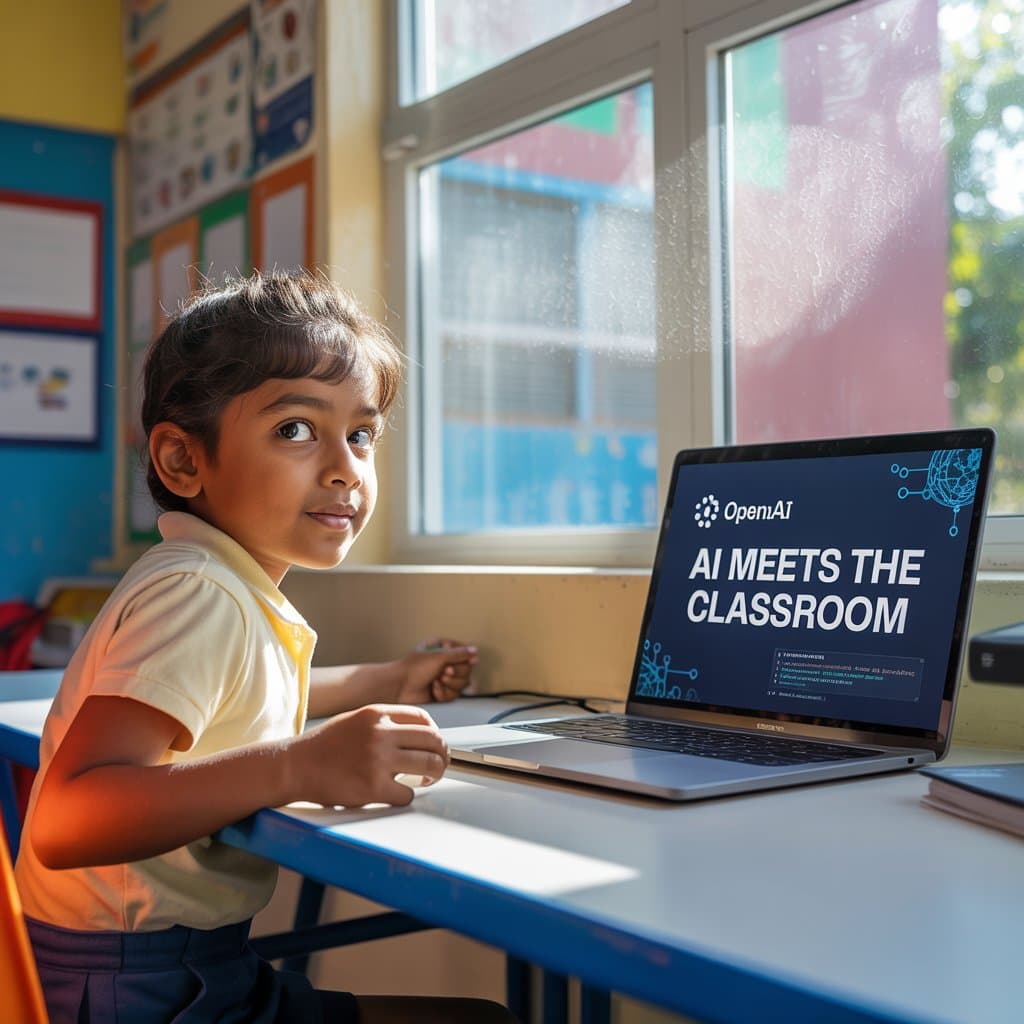
Picture stepping into a classroom where a student can get an AI to break down a difficult math equation in a matter of seconds, or where a teacher can generate a personalized quiz for each student with a few clicks. This is not a vision of the future; it’s already happening in India. Using OpenAI’s tools, schools, colleges, and edtech platforms are changing the way students learn, teachers teach, and knowledge is shared.
The Rise of AI in Indian Classrooms
Artificial intelligence in education involves the implementation of advanced technologies to improve teaching and learning experiences. AI is capable of evaluating student performance, personalizing educational content, and automating functions such as grading and taking attendance. AI technologies are increasingly integral to educational technology (EdTech) platforms. These platforms leverage AI to assist both learners and instructors. AI can develop quizzes, provide constructive feedback, and modify content difficulty based on individual needs.
In summary, AI provides a data-driven, tailored, and effective approach to education. The diverse applications of artificial intelligence in the educational sector enhance accessibility for learners and streamline processes for educators.
Role of Artificial Intelligence in Indian Education
Personalized Learning: AI will play a critical role in customizing learning. Conventional schools are often a one-size-fits-all type of environment. They assume that each child is alike; however, every child is unique, with their own learning style, strengths, and weaknesses. This is where AI can help with personalizing learning materials. One of the most effective methods for personalizing learning with AI is the Adaptive Learning approach. In this approach, AI assesses a learner's strengths and weaknesses in real time and makes recommendations based on personalized learning paths. Also, AI can help with personalized content recommendations, personalized assessments, personalized feedback, etc.
AI in Education for Special Needs Students: AI can provide students struggling with disability with new ways of interaction. One of the key areas where AI in education can help students with special needs is that it might facilitate the creation of lesson plans specific to the students’ needs. For example, students with speech or communication impairments can use a speech recognizer and a text-to-speech AI application to communicate with their teacher and other students.
AI for Better Teaching: AI can simplify and improve teaching in several ways for educators. AI can create unique, adaptive content tailored to each student’s learning style, provide real-time feedback based on student progress over time, and offer learning materials that utilize smart learning design to enhance understanding. AI can streamline teaching approaches beyond lesson delivery, helping teachers to do things like assess, grade, and respond to students, ultimately saving teachers’ time. Where there are adaptive technologies, AI can make it easier to engage with students who have special needs, making the classroom more equitable and effective for all learners.
Language learning: Today, learners can learn a new language virtually anywhere in the world through different AI and machine learning technologies. Multiple virtual platforms offer lessons that provide real-time feedback on pronunciation, grammar, and other language competencies. This model can also be applied to online learning in general, consisting of better accessibility and an interactive education experience.
How will this empower Students?
AI in education is not merely about smarter technology; it's about enabling students to own the learning process. AI takes learners at their own pace, allows them to review challenging concepts repeatedly, and delves into areas outside of the textbook. AI chatbots and virtual teaching assistants engage 24/7 with students, allowing them to clarify doubts immediately without having to wait for the next lecture. For rural or underserved students, this translates to access to quality learning materials that may not otherwise be accessible. Perhaps most importantly, AI fosters independent learning, inviting students to question, explore, and work on developing problem-solving skills that will serve them in life.
The Global AI-Powered EdTech Market
The Market will grow at a CAGR of 41%
Source: 8allocate
The global generative AI in EdTech market is on a steep growth curve, as shown in the forecast from 2023 to 2033. Starting at just $268 million in 2023, the market is expected to expand rapidly, crossing $1 billion by 2027 and nearly $3 billion by 2029. The acceleration becomes even more dramatic in the 2030s, with projections of $4.1 billion in 2031, $5.9 billion in 2032, and ultimately $8.3 billion by 2033. With a projected CAGR of 41%, this growth highlights how generative AI is set to become a transformative force in education worldwide. For Indian edtech companies, this signals enormous potential, not only to innovate with AI-driven learning solutions but also to scale globally in a rapidly expanding market.
Conclusion
Consider how you studied at school: books, classes, perhaps a couple of computers. Now visualize a school where each student receives a tailored journey, where at midnight a chatbot resolves your confusion, and where students from even the remotest areas of India can learn to the same level of quality as students from large cities. That's the revolution AI is unleashing on learning today.
For educators, it's a wise assistant that deals with grading, quizzes, and mundane tasks so that they can spend more time on creativity and mentoring. For students, it's freedom, freedom to learn at their own pace, explore outside the syllabus, and develop true problem-solving skills.
As the EdTech market expands rapidly, the scope for growth and innovation is immense. India isn't merely embracing AI in learning; it can become a global trendsetter. The true question is: how prepared are we to welcome this future classroom?