


The reality is that global conflicts aren’t fought with weapons anymore, they're fought with ideas, data, and innovation. Today, the race for AI leadership is about far more than technology. It will shape how governments operate, how economies grow, and how power is shared across the world. AI has moved beyond being just a handy tool, it’s becoming the backbone of economic strength and global influence. The countries that lead in AI today will have the biggest say in shaping the technologies and rules of tomorrow.
AI is already changing our daily lives. From smart assistants and self-driving cars to automated factories and predictive healthcare, it’s transforming how we live, work, and move through the world. On a larger scale, it’s redefining how nations compete, influencing cybersecurity, defense, and national power.
But rapid progress comes with real challenges. Privacy concerns, job disruption, bias, and ethical questions are growing. How countries balance innovation with responsibility will determine whether AI becomes a force that drives shared progress or one that deepens inequality in the years ahead.
Why AI Leadership Matters?
AI leadership is the main factor that determines a nation's economy, security, and global influence. The leading countries are employing AI to revolutionize various sectors such as healthcare, finance, manufacturing, and transportation. As a result, the U.S. is the innovation driver in areas like autonomous vehicles, AI based drug discovery, and cloud platforms, whereas China leverages AI in smart factories and supply chains to increase efficiency and lower costs.
Moreover, AI is the key enabler of national security in the future, as it empowers governments with the capabilities for cyber defense, intelligence, and selectively operated systems for detection threat and decision, making. The adoption of AI by the EU, elevates the role of countries in global AI governance through policies regarding ethics, transparency, and data privacy.
Last but not least, AI leadership gives the leverage to countries to stay relevant in the near future. India is a perfect example of a country rallying the AI education, startups, and digital infrastructure for the purpose of becoming a global AI hub. Countries that are making the right moves in terms of talent, research, and infrastructure today are likely to be winners in the future world which will be dominated by AI.
The Global AI Race: Key Players and Strategic Strengths
“The global race to lead in artificial intelligence is being led by a small set of countries that are setting the way in which AI is developed, used, and regulated globally. Instead, the competition has turned into an ongoing battlefield where every country is advancing in its own unique way,” Mike Wade, executive director of the Tech Policy Press, said.
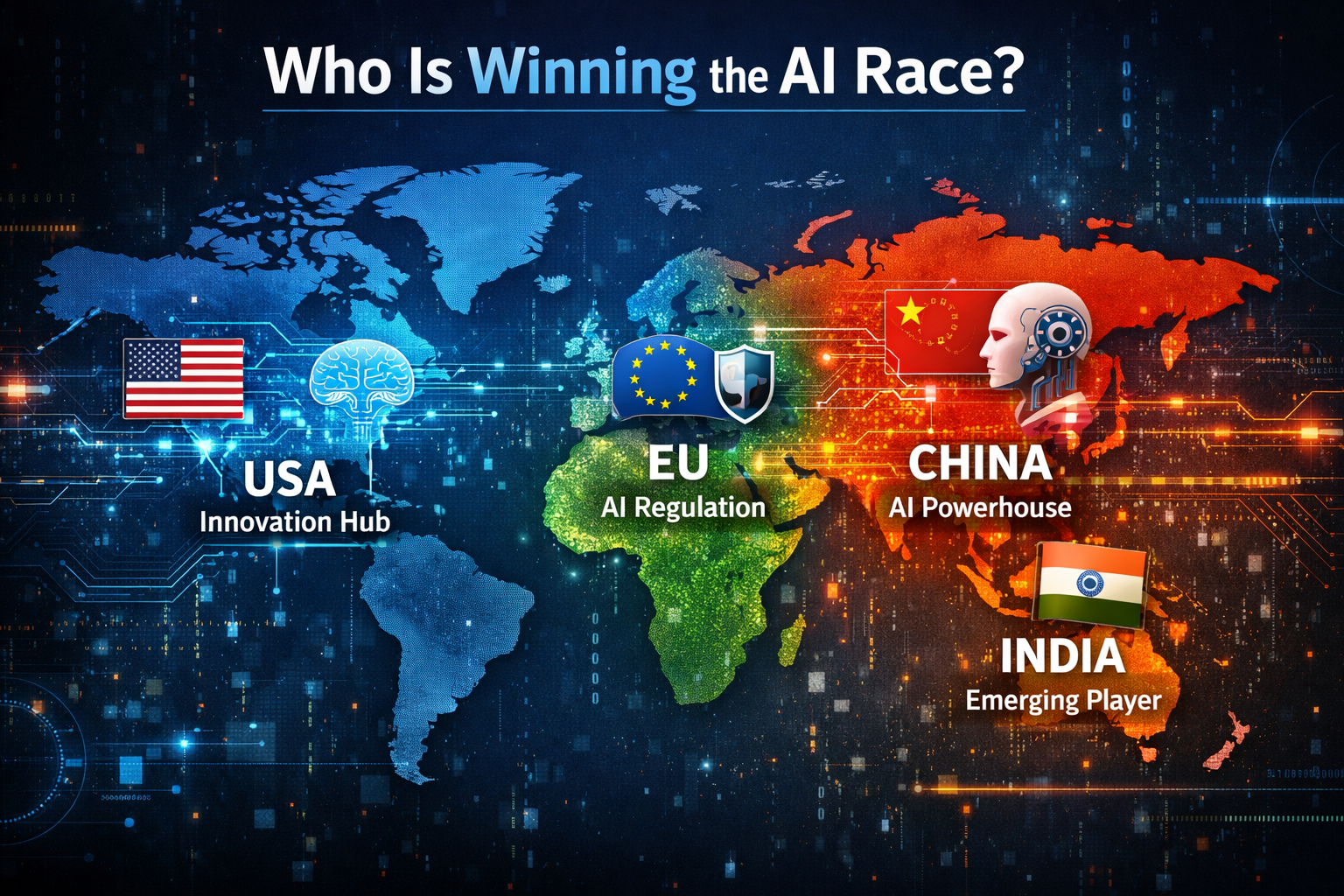
United States: The US still leads the global AI innovation ecosystem thanks to their tech giants, top universities, and heavy investment. It leads through its effectiveness in translating cutting-edge research from AI to practical applications such as self-driven cars, AI-assisted healthcare for discovering drugs, and cloud computing platforms.
China: China is closing the gap at an incredible pace with the widespread adoption of AI on a gigantic scale. Because of their strong support and their ability to tap into their vast datasets, their applications of AI are ingrained in various sectors and allow China to implement their AI solutions with ease and efficiency.
European Union: The European Union is leading in the efforts to ensure responsible use of artificial intelligence. Through its emphasis on ethical considerations, transparency, and data protection, the European Union is establishing a benchmark across the world, in spite of the slow pace of innovative progress in the region, as opposed to the U.S. and Chinese rates.
India: There is a steady emergence of India as a future AI leader. Being home to talented individuals as well as having a developing startup ecosystem coupled with digital infrastructure, the country is heavily investing in AI-related education and research to ensure they get a significant share of the next wave of growth in AI globally.
Still, there is a long way to go in this race involving AI. The nations that have a bright future in shaping AI will be those that can manage technological innovation along with talented resources, scalability, along with proper usage for economic growth as well as societal benefits.
The Effects of AI on Companies and Communities
The global AI race is not only a matter of national prestige but also has a significant impact on businesses and society. First, mover companies in AI enjoy a competitive advantage as they can use the technology to improve efficiency, customer experiences, and innovation. For instance, AI enabled automation can take over repetitive tasks, data analytics can provide actionable insights, and AI generated recommendations can customize the products or services on a one, to, one basis.
AI also has a major societal impact. Besides improving healthcare, education, transportation, and public services, AI can equip citizens to have more agency and participation. At the same time, AI raises anxiety about job losses, privacy, and discrimination, among others, in need of appropriate responses from policymakers and regulators.
Those companies and administrations that make diligent AI investments, undertake workforce reskilling, and commit to ethical standards will profit and survive the rapid upheaval. The decisions today will determine the economic, social, and technological aspects of the future.
The global race for AI leadership is reshaping economies, governance, and power. How nations balance innovation, ethics, and talent will define the future.
The race to lead in AI is already changing how the world works economically, technologically, and socially. Governments are pouring resources into research, infrastructure, and talent, while businesses that embrace AI are gaining a real edge by working faster, smarter, and more efficiently. At the same time, people are beginning to see the benefits of AI in everyday life, from better healthcare and smarter transportation to more accessible education and cleaner cities.
But progress doesn’t come without challenges. Concerns around privacy, job disruption, bias, and ethics are growing alongside AI’s rapid adoption. The countries, companies, and communities that will truly succeed are those that treat AI as more than just a tool for growth , using it responsibly, thoughtfully, and with people at the center. When guided by strong values, AI has the potential to tackle some of the world’s biggest problems, empower communities, and help create a future that is not only more advanced but also more fair and inclusive.
Final Thoughts
The race to lead in AI is already changing how the world works economically, technologically, and socially. Governments are pouring resources into research, infrastructure, and talent, while businesses that embrace AI are gaining a real edge by working faster, smarter, and more efficiently. At the same time, people are beginning to see the benefits of AI in everyday life, from better healthcare and smarter transportation to more accessible education and cleaner cities.
But progress doesn’t come without challenges. Concerns around privacy, job disruption, bias, and ethics are growing alongside AI’s rapid adoption. The countries, companies, and communities that will truly succeed are those that treat AI as more than just a tool for growth , using it responsibly, thoughtfully, and with people at the center. When guided by strong values, AI has the potential to tackle some of the world’s biggest problems, empower communities, and help create a future that is not only more advanced but also more fair and inclusive.