

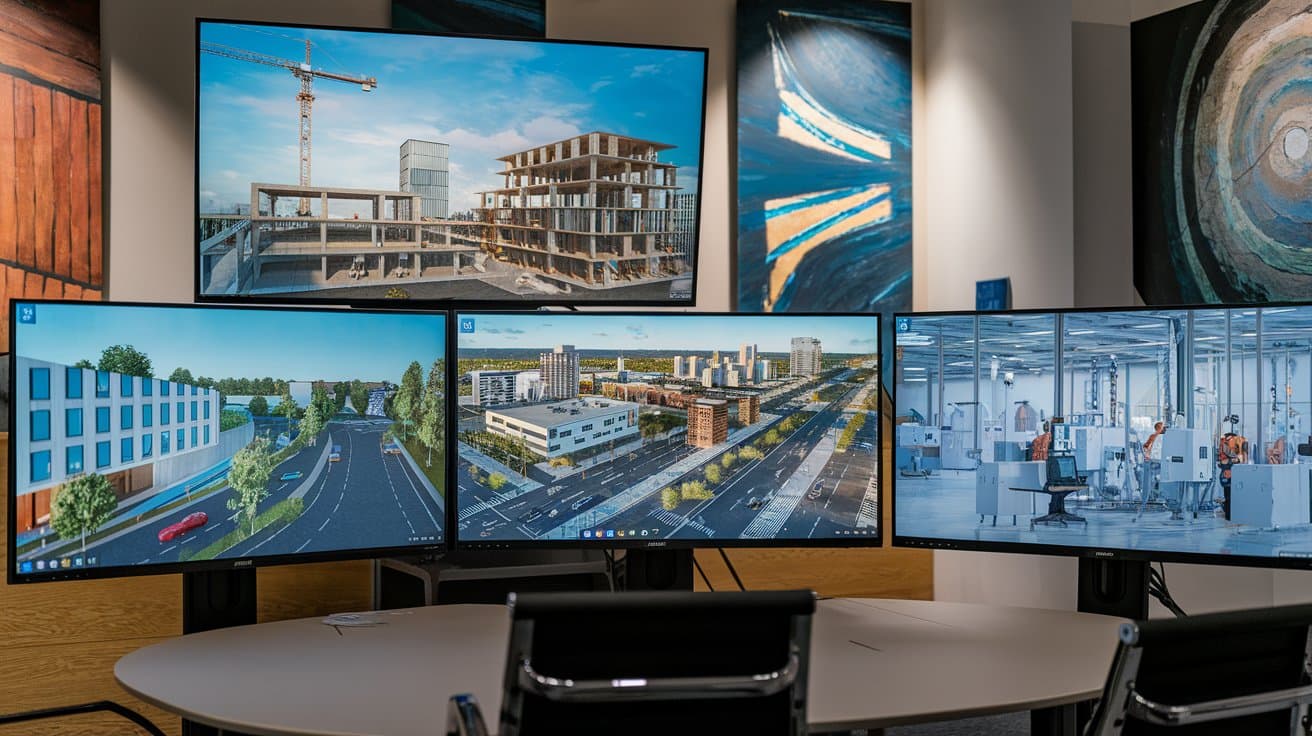
Have you ever wondered about creating a virtual replica of a physical object, process or even a city? Just imagine having a digital version of a car that simulates every detail of its performance, a city model that predicts traffic flow, or a factory layout that can be optimized without disrupting production. Yes, you can, That is what digital twin technology offers: the innovation of mirroring the physical world into a virtual one, offering the prospect of analyzing, testing, and enhancing systems in ways that we haven’t seen previously. What are digital twins, where can we see digital twins, and what are the benefits and challenges? Let's explore the world of digital twins.
What is a Digital Twin?
A virtual version of a system or object that is intended to faithfully replicate a real one is called a digital twin. It incorporates simulation, machine learning, and reasoning to aid in decision-making, covers the object's lifecycle, and is updated based on real-time data.
What is the History of Digital Twins?
David Gelernter introduced the idea of digital twins in his 1991 book "Mirror Worlds." Michael Grieves of the Florida Institute of Technology later used the idea in manufacturing. At a Society of Manufacturing Engineers conference in Troy, Michigan, in 2002, Grieves formally presented the digital twin concept after relocating to the University of Michigan. However, the digital twin concept was initially adopted by NASA, and NASA's John Vickers gave it its name in a 2010 Roadmap Report. The concept was applied to the development of computer models of spacecraft and capsules for testing. When Gartner listed the digital twin notion as one of the top 10 strategic technology trends in 2017, it gained even more attention.
Since then, the idea has been applied to an increasing number of industrial processes and applications.
How to Design Digital Twins?
- Data collection: The sensors implanted within the physical objects or systems collect real-time data that includes environmental conditions, structural integrity, and operational metrics, among others, and even contextual information by collecting data through its various processes.
- Modeling and Simulation: The data can be fed into a virtual model that duplicates the real-world object's behavior and performance. Such a digital replica can predict how the real-world object would react to different inputs or conditions given a scenario.
- Connectivity and Feedback Loops: Digital twins are not static but constantly updated. This can be used to share data in real time so the virtual model can "learn" or change based on what is happening in physical space.
What Are the Benefits of a Digital Twin?
- Performance improvement: The digital twins provide real-time information, which will improve the performance of your equipment or plant. Problems can be resolved as they arise, guaranteeing optimal system performance and minimizing downtime.
- Predictive capabilities: Digital twins will give you a complete representation of your manufacturing plant or facility. Every component's output is tracked by smart sensors, which
identify problems or defects as they arise. Instead of waiting for equipment to break down entirely, you may intervene as soon as issues are noticed. - Helps in R&D: Digital twins help in effective research and product design, creating data regarding probable performance outcomes. Before beginning manufacturing, businesses can use the information to gain insights that assist them in developing their products.
- Able to do remote monitoring: due to the virtual nature of digital twins, you can remotely monitor and control it.
- Can save production time: you can save production time on products by building digital replicas. By using digital twins, you can see what are the factors that negatively affect your product or facility and you can make necessary adjustments to reduce risk factors and save production time.
Where is it Used?
- Manufacturing and Industry: Digital twins ensure predictive maintenance in manufacturing by saving time, and avoiding downtime. Digital process testing allows firms to experiment with different scenarios and optimize their operations with the experience of disrupting existing processes. Digital twins form an important constituent of Industry 4.0-the fourth industrial revolution.
- Healthcare industry: The same idea can be applied to simulate the disease of individual patients. Digital twins in the healthcare industry are allowing the possibility of personalized medicine with an exact treatment method. For example, a digital twin of the heart can be designed for treatment or surgery so that physicians can try various options on it without endangering the patient. It would eventually translate into individually customized treatment plans, as it relates to the unique physiological traits each individual possesses.
- Smart Cities and Urban Planning: The digital twin helps cities optimize urban planning. The model simulates the copied infrastructure, utilities, pattern of traffic, and more of the city. Cities like Singapore and Helsinki have taken its adoption for monitoring and planning their urban development, reduction of emissions, and management of resources.
- Automotive and Aerospace Engineering: The digital twin has been the fuel in all processes from designing to maintaining products in the automotive and aerospace industries. Automotive companies use the digital twin to simulate the performance of cars under different conditions, thus enhancing safety, fuel efficiency, and handling. Companies in the aerospace industry use digital twins to supervise planes in real-time by anticipating problems before they cause any damage.
- Disaster Management: Global Climate Change has gotten a hold of the world over the past decades. However, this challenge can be handled effectively with the application of digital twins that can inform the development of smarter infrastructures, emergency response plans, and even climate change monitoring systems.
What Are the Challenges in Implementing Digital Twins?
The idea of digital twins is a game changer but very challenging to implement. Digital twins are created by developing high-quality data, powerful computing resources, and putting data together between physical and digital systems. Digital twins store sensitive operational data, and because of this, ensuring cybersecurity is critical. Also, processing real-time data for digital twins needs high speed and requires a strong IT infrastructure and specialized skills, which can be challenging for some firms. The real struggle lies in the cost and long-term maintenance of the technology, where businesses find it difficult to access sufficient amount to implant the digital twins and the long-term implementation can also be a struggle for businesses.
What Will Be the Future of Digital Twins?
The market for digital twins is expected to grow exponentially as companies and researchers continue to expand to more applications. This is because digital twins, with the enhancement and transformation of such technologies as artificial intelligence, IoT (Internet of Things), and cloud computing, will have more capabilities. Most probably, a digital twin can be a key for managing whole cities, optimizing the health care system, and even offering sustainable practices in aspects of simulating environmental impacts. Digital twins will redefine how to interact with the physical world by carrying continuous improvement of connectivity and the analysis of data. It used to be a dream in science fiction movies and novels. Now it's going to be at the heart of true innovation giving us profoundly new ways of comprehending, controlling, and optimizing our immediate surroundings.