


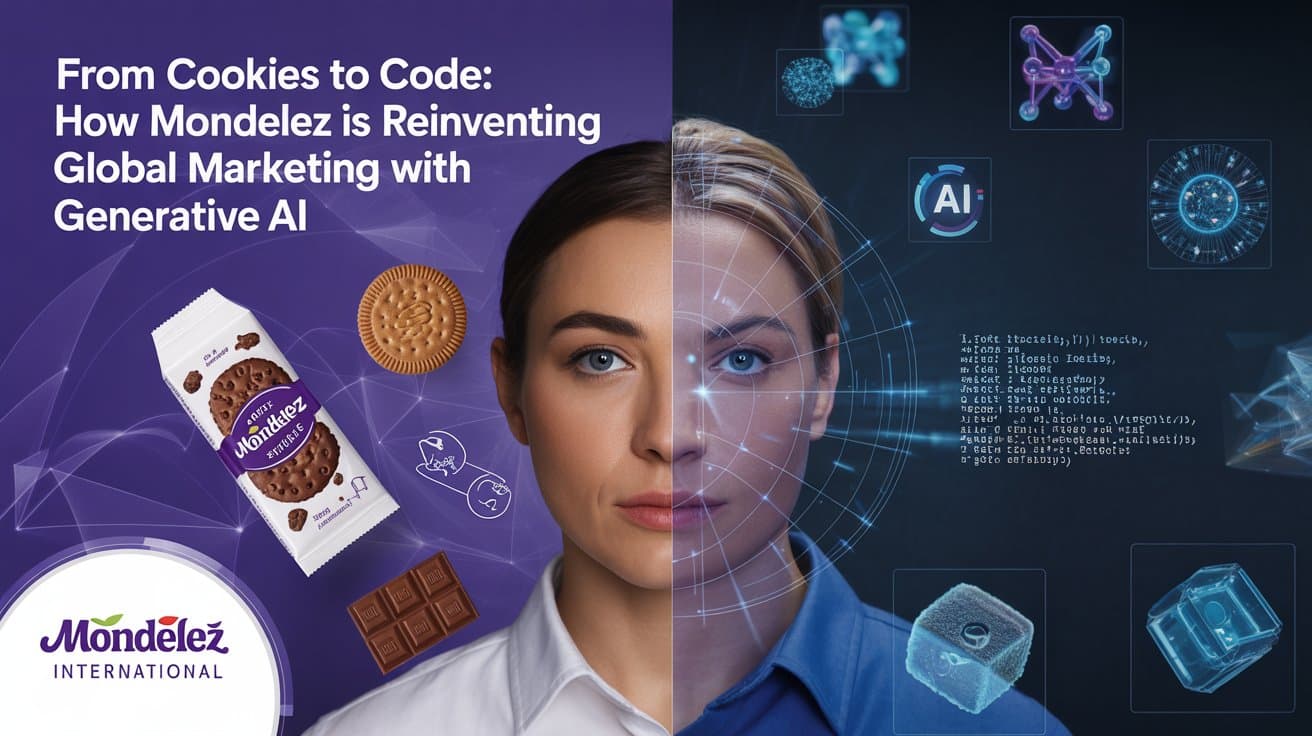
Mondelez International the powerhouse behind Oreo, Cadbury, and Chips Ahoy is quietly transforming how global marketing operates. With a $40 million investment in its proprietary Generative AI platform, the company is moving beyond traditional content creation toward a faster, more intelligent, and more scalable marketing model.
This shift isn’t about replacing human creativity. It’s about giving creativity room to move at the speed of culture.
Why Mondelez Made the Shift?
Constant change is what mainly characterizes today's marketing landscape. Consumer attention spans are continually shifting, digital platforms require new content every day, and global brands have to keep up their image in more than fifty markets simultaneously. However, on the other hand, traditional content production, especially in animation and video, is still slow and costly.
With the help of AIDA, an AI tool, Mondelez is planning to make the content production process cheaper by half to a third of the current costs and shorten the creation time from several weeks to just a few hours. This gives marketing teams the opportunity to react to trends in real-time, try out several creative versions, and provide more individualized experiences without increasing their budgets.
Also, these great improvements in work performance are not the only things that matter to the company. The company will be able to use the freed-up resources for spending on media reach, innovation, and deeper consumer engagement.
What Makes AIDA Different?
Unlike regular AI tools, AIDA is a home-grown solution and trained only on Mondelez’s brand assets, brand guidelines, and performance data. The AI thus gets brand tone, brand visual identity, and brand storytelling nuance and ends up producing content that is brand authentic rather than brand automated.
In order to scale AIDA worldwide, Mondelez collaborated with Accenture to establish a solid data foundation and facilitate enterprise adoption, Publicis Groupe to drive creative execution and responsible AI governance, and Google Cloud to deliver the speed and the infrastructure required for rapid, content delivery across the globe.
The effect is a system where data is the source of creativity and creativity is quicker than ever.
Early Results: Where AI Is Already Creating Impact
AIDA is already being used to generate social media content for brands like Chips Ahoy in the United States and Milka in Germany, producing short animated videos that adapt visuals and environments based on audience context. These assets maintain a consistent brand identity while feeling locally relevant a long-standing challenge for global marketers.
Beyond awareness campaigns, AIDA is also enhancing Oreo product pages on Amazon and Walmart, improving visuals and descriptions at the digital shelf. This brings AI directly into the revenue engine, influencing purchase decisions at the moment they matter most.
These early use cases demonstrate that Generative AI isn’t just a creative tool it’s a performance driver.
Measurable Results: What This Strategy Is Delivering
Mondelez's Generative AI strategy is a good example of how technology can be a significant lever for business growth. The company has been able to cut content production costs by up to 50% through the use of AIDA, while the time for creation has been reduced from weeks to just a few hours, thus marketing speed and agility have been significantly increased. The fast turnaround enables a larger number of creative versions to be tested by teams, campaigns to be efficiently localized, and cultural as well as market trends to be responded to in almost real-time.
Additionally, AIDA helps in maintaining global brand consistency which is beyond the issue of cost and speed. This ensures that campaigns are in line with brand guidelines even though they are still adapting to local markets. High-performing visuals and messaging can be quickly scaled through data-driven optimization, thus overall campaign effectiveness is improved. The automation of certain processes has allowed creative teams to be liberated from the drudgery of repetitive tasks and thus more storytelling, innovation, and strategic planning of a higher value can be focused on by them. Meanwhile, at the point of sale, the use of AI for content on platforms like Amazon and Walmart has helped in the improvement of visual clarity, engagement, and conversion rates. In summary, the AI strategy of Mondelez is a good example of how a company can achieve a quicker, more efficient, and performance-driven marketing model while at the same time creativity is not jeopardized but rather there is a balance between the two with measurable impact.
Responsible AI, Built into the System
Mondelez has been very methodical in how they have brought AI into their operations, with brand trust being the key factor in their strategy. The firm does not resort to AI creating human faces that look real but rather concentrates on the use of animation and product storytelling. Before any AI-generated content goes to print, a human review is done to ensure that the quality, accuracy, and brand value alignment are maintained.
Well-defined internal rules also help to avert any unhealthy or deceptive messaging that would be contrary to Mondelez's role as a global food company. This "human-in-the-loop" method is a way of ensuring that AI is used for a higher level of decision-making and not to substitute it.
What Comes Next?
Mondelez’s roadmap for AIDA is ambitious but carefully phased. The company expects to expand AI-assisted content into television advertising by 2026, with the potential for a Super Bowl campaign in 2027. If achieved, this would mark a major shift in how premium advertising is produced, combining scale, speed, and storytelling in ways previously impossible.
Final Thought
Mondelez's Generative AI journey is not just a technology upgrade, it's a strategic reset of how global brands create, scale, and connect. Combining human creativity with AI-driven speed and precision, the company is transforming marketing from a slow, expensive process into a living, adaptive system.
What separates Mondelez from the 40 million dollars is not only the investment, but also the discipline: creating its own infrastructure, maintaining brand trust, and ensuring that humans remain in control. This balance allows the company to have the speed of innovation without delivering to the customers what they value least.
Mondelez, from cookies to code, is telling the industry what comes next: marketing that is more intelligent, quicker, and are still deeply human at their core. The brands that take this route will not only be able to keep up with the change they will be the ones to shape it.