


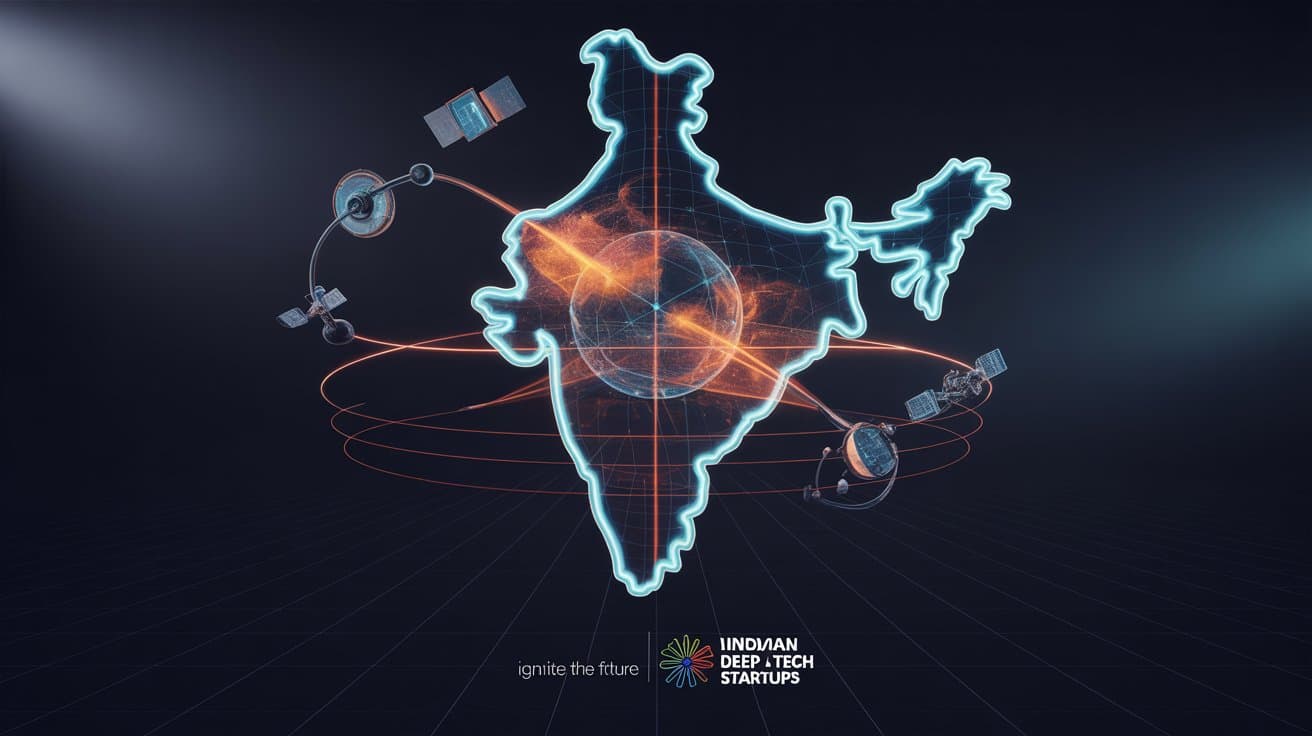
What connects AI-powered satellites, rapid disease diagnostics, and next-generation batteries?
They're all being developed in India, and they solve problems not only at home but globally. For the last few years, a quiet wave of activity has stirred the Indian startup ecosystem. It isn't food delivery services or ridesharing companies. This wave is deeper, quite literally. Indian entrepreneurs are swimming into deep tech: AI, machine learning, space tech, quantum computing, robotics, and more.
And the impact? It's beyond purely local.
Startups from Bengaluru, Hyderabad, and Pune are driving innovations that power hospitals in New York, support space missions in Europe, assist farmers in Africa, and enhance electricity grids across Southeast Asia. These are not just startups; these are problem solvers with a global mission. So, how did India become an emerging player in deep tech? What sectors are being impacted? What does it mean for the global innovation ecosystem?
Let's explore.
The Rise of Deep Tech in India
In the past, Indian startups were just known for IT services or mobile. But there is a shift that is happening. As per a report by Nasscom, "The number of deep tech startups in India has increased by over 50 percent in the past five years." Indian founders are now solving tough global problems that need advanced tech and innovation. They have support from skilled engineers, government programs like Startup India and Digital India, and better access to global funding.
Areas Where Deep Tech Is Creating Global Ripples
- Healthcare and Life Sciences: Startups like Qure.ai are using AI to interpret radiology scans within seconds, bringing advanced diagnostic tools to even the most remote corners of the world. SigTuple is working on automating medical analysis to alleviate the shortage of pathologists in both developing and developed countries.
- Space Tech: Some Indian companies (like Pixxel) are constructing satellite constellations for imaging the Earth at a high resolution for applying it to agriculture, defense, and climate change monitoring. Their innovations are pulling clients and collaborators from all over the world, including NASA and the European Space Agency.
- Agritech: Deep tech-enabled agritech startups, such as Cropin and Fasal, are providing farmers with real-time insights and optimizing yield for farmers all over the world using AI, satellite imagery, and IoT sensors.
- Cybersecurity: Startups like Sequretek are transforming cybersecurity by automating endpoint protection and providing AI-driven threat intelligence and response to organizations across the globe. As cyberattacks and related vulnerabilities become increasingly sophisticated, Indian solutions are becoming a required part of the global digital defense strategy.
- Climate Tech: Climate change is a worldwide problem, and deep tech-enabled Indian startups, like Log9 Materials, are enabling innovation in energy storage and clean tech. Their deep tech focus leads to the development of fast charging batteries and fuel cells serving a variety of markets from Southeast Asia to Africa.
What Sets Indian Deep Tech Startups Apart?
- Cost-effective and Scalable: Indian startups are good at keeping costs low and building systems that still work well, even if not perfectly set up, a big plus in growing markets.
- Global Perspective: Many startups are "Born Global" and want to tap into international markets, from day one, using cross-border accelerators, VC networks, and collaborators.
- Bridges to Academia: There has been increased linkage with top institutions ( IISC, IITs, and research labs ) and a strengthened innovation pipeline.
- Policy Support: Policies such as the National Deep Tech Startup Policy are intended to support building the ecosystem with funding, IP support, and connecting internationally.
Challenges to Overcome
While the momentum of Indian deep tech startup activity improves, these startups face numerous challenges. International rules and approvals can take a long time and be complicated, especially in tightly controlled areas like health, defense, and finance. Scaling deep tech products can be very capital-intensive, and often these deep tech products require complex engineering. Oftentimes, this includes the consumption of significant resources, human efforts, time, and so on. Other than the costs, trust is often missing in emerging deep tech brands in many global markets; therefore, without adequate trust being built, it will be difficult to earn credibility. Still, there are many positive signs, with investors showing increased confidence, improved policy-making frameworks, and many new startups finding global success.
The Road Ahead
The deep tech movement in India is beyond the early stage; it's a broad, rapidly expanding, and globalizing space. These startups keep innovating, collaborating, and scaling, not only putting India on the map in terms of global innovation but also solving many of the world's most pressing challenges.
From Bengaluru to Berlin, from Pune to Palo Alto, Indian deep tech is going global, and this is just the beginning.