


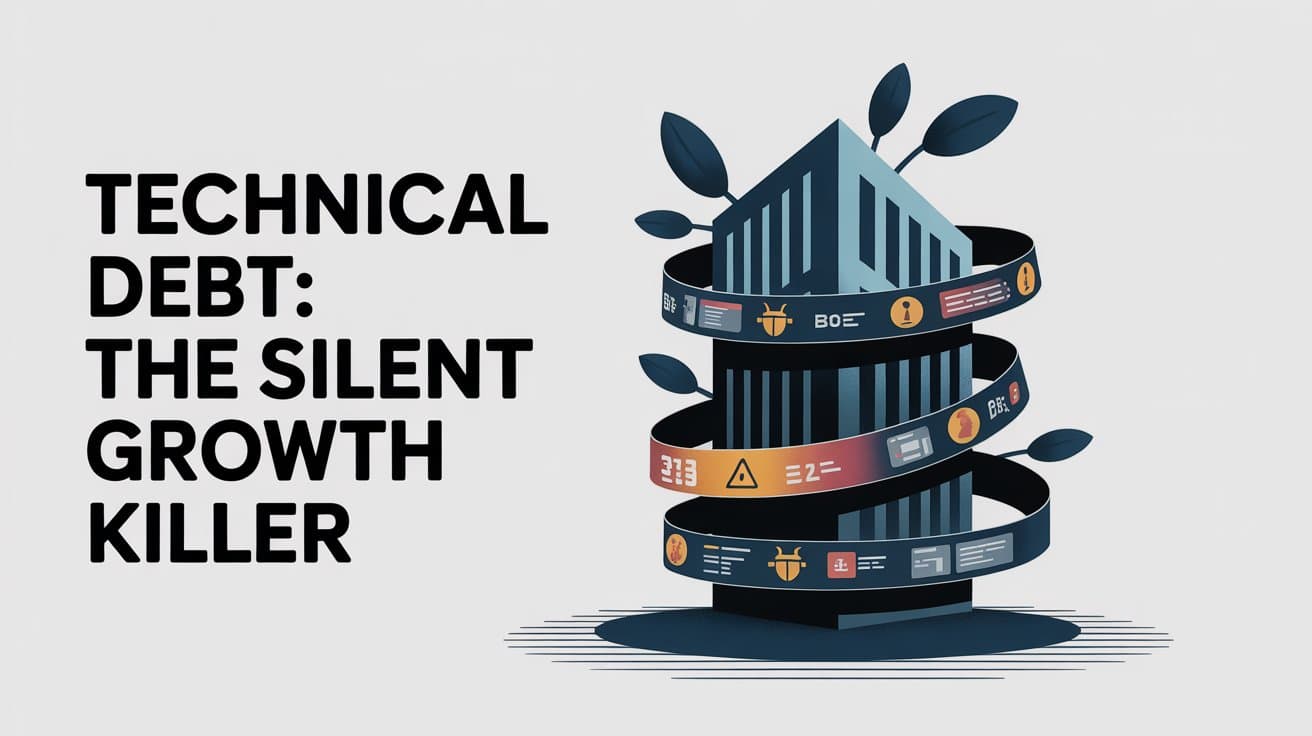
Most of the time technical debt originates from good intentions. The deadline is near, there is a feature that needs to go live, and someone says, Its not perfect, but it works. Well fix it later. Right then and there, speed becomes more important than structure, and often, it really is. The product moves forward, users are happy, and everything seems fine.
But after a while, small changes start to take longer. Unexpected bugs appear. Developers are reluctant to modify certain pieces of code. No one part is totally broken, but the whole thing feels difficult. That is technical debt. It is not a disaster that happens suddenly. Instead, it gradually accumulates and the teams get less productive and instead of growth, they feel friction.
What Is Technical Debt?
Technical debt is essentially the indirect cost of deciding on speed at the expense of a high, quality code base that can last over time. Simply put, it is the extra effort a team will have to put in at some point because they took shortcuts during the development.
Think of it like borrowing time, every single lets just make it work for now is creating additional work that later on will usually be more expensive to fix.
Such debt often manifests itself in the form of:
hardcoded logic that is not easy to change, missing or unclear documentation, inconsistent coding practices, tightly coupled systems where a single change impacts many others, lack of automated tests which results in bugs going unnoticed.It is fine and sometimes even is a part of the strategy to have a little technical debt,
How Technical Debt Sneaks In
Technical debt doesn't usually arise from badly engineered low quality works. On the contrary, it is the pressure that leads to technical debt. There can be very tight deadlines, and the top priority can be changed several times, so a shortcut can be the only way out. Every choice looks small and reasonable at that time.
Yet, these minor concessions accumulate. A piece of work that took a few probably hours now takes days. Solving one problem, in fact, leads to another problem. Programmers start to stay away from some sections of the system because they are dangerous or difficult to understand. What at one time made the speed possible gradually turns into a barrier. Technical debt is not a herald of itself, it grows silently through the ordinary decisions.
The Hidden Costs of Technical Debt
Technical debt usually starts off as an easy thing to overlook. The product functions, the features get released, and the users are happy. However, the cost of the debt becomes inevitable with time. The development process stagnates, the product needs more upkeep, and the teams spend more time resolving the legacy issues than developing new features.
Besides the effect on productivity, technical debt impacts people too. Developers get frustrated and work more cautiously. The newcomers have a hard time understanding the system. The confidence in the release decreases, the innovation gets postponed, and the acquiring of the growth becomes difficult. Most of the time when such issues become apparent, it is considered that the debt is already too costly to be fixed.
How to Identify Technical Debt Early
One can spot technical debt when even the most minor adjustments no longer seem straightforward. Tasks that are supposed to take a few hours keep getting extended into days. Issues that have been fixed continue to return. Teams become reluctant to make changes, and some areas in the code seem like "forbidden."
A big indicator is also the inability to onboard newcomers easily. If new developers struggle for too long to figure out the system or get overly dependent on others even for trivial changes, in most cases, the reason is the accumulated technical debt. If releasing updates feels more like a nightmare than a source of security, then the system probably has more debt than it should have.
When Technical Debt Is Acceptable and When It’s Not
Technical debt is not necessarily a bad thing in all cases.
In early, stage products, MVPs, or crucial launches, it is sometimes productive to take shortcuts to save time and learn faster. In these situations, the debt is a deliberate compromise.
On the other hand, it turns out to be a problem if there is no plan for its remediation. Debt that disregards security, data handling, payments, or core architecture is particularly dangerous. When teams are hesitant to make changes or are frequently putting out fires caused by bugs, technical debt no longer serves as an aid and starts to hinder growth. The real problem is not the accumulation of debt but the denial of its existence.
How to Manage and Reduce Technical Debt
Keeping technical debt under control doesnt have to be a trade, off for the speed of development. Its about being able to move fast and still stay in control. Initially, the debt has to be made visible and it has to be treated as actual work, not something to fix someday.
Identify the areas that are most painful and focus your work efforts there: the parts of the system that keep giving bugs or that hamper your team's progress as a whole. Slowly but steadily, work on the fixes for technical debt in parallel with feature development, rather than all at once. Automated tests are very helpful in this process since they make it much safer for a team to refactor and polish the code. If shortcuts are taken, they must be documented well with a strategy to address them later on.
Dont strive for perfect code but rather for a codebase that is adaptable, understandable, and easy to expand.
Technical Debt Decides Your Future Speed
Technical debt is secretly the factor that determines the pace at which your product can change. It is a kind of a shortcut, which either gives you a speed boost in the beginning or later turns into a burden, depending on how you handle it.
The teams that are aware of their technical debt in time, address it, and plan the management of it, are the ones that can run quickly without making mistakes and without getting exhausted. In the end, all kinds of debts will be settled one way or another through regular improvements or through an emergency situation.