

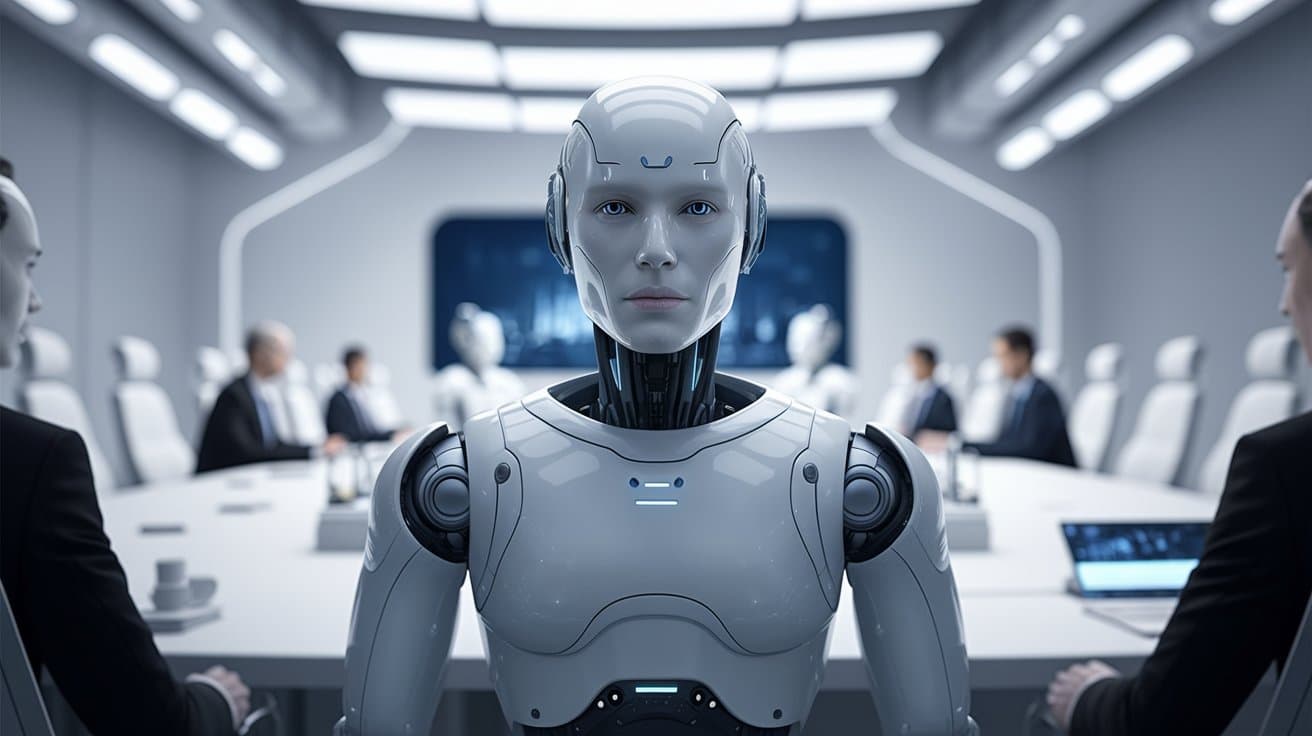
Artificial intelligence in business has progressed from mere automation to decision-making and strategy formulation. AI-powered analytics, predictive modeling, and operational effectiveness tools are now a necessity in most industries. But can AI extend beyond supporting human executives and assume the CEO position?
A historic event unfolded when NetDragon Websoft, a company based in China, designated an AI program called Tang Yu to take on the role of CEO. This AI-driven virtual humanoid robot was given the responsibility of aiding in decision-making for the company's everyday activities. Following this appointment, the company's stock saw substantial increases, outpacing Hong Kong's Hang Seng Index and raising the company's valuation to over $1 billion.
Similarly, The first-ever humanoid robot was recently appointed Chief Executive Officer (CEO) of a multinational corporation. Polish drinks company Dictador said it has named the AI-powered humanoid robot 'Mika' to head the company. Mika is a board member who leads operations on Dictador's behalf and is the first female CEO robot. Mika is a research initiative that involves a collaboration between Dictador and Hanson Robotics, a robotics and engineering firm from Hong Kong recognized for creating lifelike robots equipped with AI for various uses in consumer, entertainment, service, healthcare, and research sectors. The two companies tailored the robotic CEO to embody the organization and its distinct values.
With modern developments in machine learning, big data, and automation, there may not be any reason to rule out the possibility of an AI-driven CEO. AI leadership is a powerful way to bring benefits, such as data-informed decision-making, as AI can analyze enormous quantities of data in real-time, and can make objective and knowledgeable decisions, unconstrained by human bias. In contrast to human executives, AI is operational 24/7, enabling continuous observation and instantaneous feedback in the event of business challenges. Moreover, AI-based leadership has the potential to decrease administrative costs and benefits while maintaining consistency and adherence to legal and ethical codes, devoid of individual bias.
However, there is an absence of human intuition, emotional intelligence, and moral reasoning which are required for the effective function of leadership. Sometimes, data-driven decisions may suffer from undesirable effects such as job displacement or unethical profit-oriented approaches. Trust and adoption are also a challenge since there can be reluctance among stakeholders, employees, and customers to have an AI leader. Legal and regulatory barriers are also a challenge.
The Future: AI as a Co-Leader?
Rather than completely replacing human CEOs, AI should act as a sophisticated decision-making assistant, enhancing leadership rather than taking its place. A hybrid leadership model, where AI collaborates with human executives, could leverage the strengths of both, resulting in a more effective and adaptable management approach. Human principals have key attributes, including vision, ethics, creativity, and emotional intelligence which are critical for inspiring teams, stimulating innovation, and handling ethical dilemmas. In contrast, AI provides unprecedented data-driven accuracy, real-time analytic function, and operational efficiency, enabling companies to take more decisive, objective, and well-informed action. Human executives working collaboratively can focus on high-level strategy and long-term goals, whereas AI can focus on data analysis, risk evaluation, and process automation of business processes. Through this collaboration, it is possible to achieve smarter decision-making, lower bias, and better corporate governance, which ultimately directs companies to move towards higher efficiency and innovation, and safekeeping of the human characteristics greatly valued for both leadership and organization culture.
While we may not see an AI CEO at the helm of a Fortune 500 company yet, AI-driven leadership is already influencing the business landscape. The challenge is to find the right balance between technological progress and human oversight, making sure that AI supports decision-making while preserving the essential human traits that characterize effective leadership.
Would you feel comfortable with a company being led solely by AI? Share your opinion with us.