


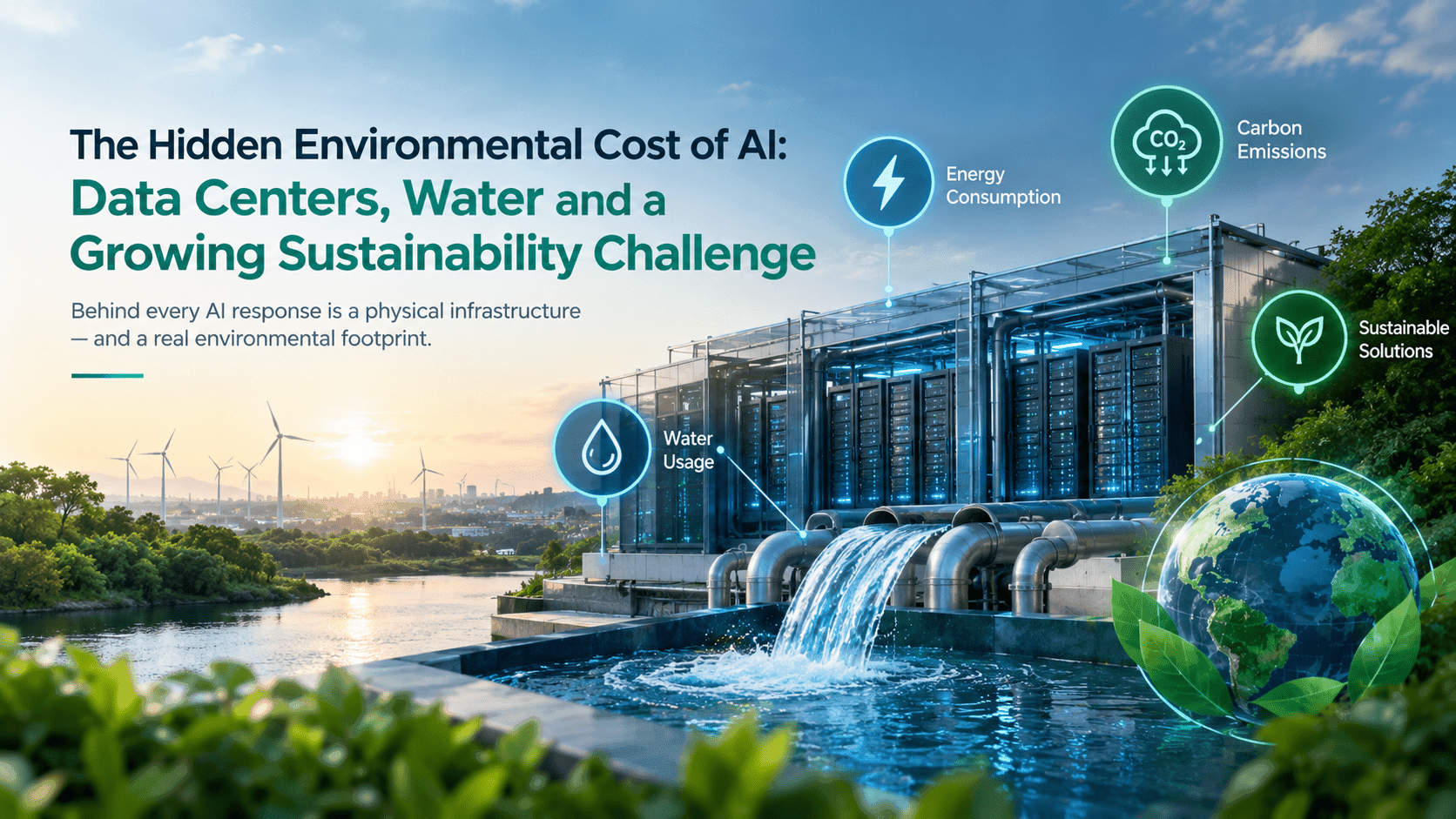
Have you ever thought about what happens behind the screen when you ask AI a simple question?
You type a question, get an answer in seconds, and move on. But somewhere behind that quick response, powerful servers are working inside a data center, and all that computing generates heat that needs to be cooled.
That cooling can require large amounts of electricity and, in many data centers, water. As our dependence on AI grows, so does the infrastructure supporting it.
Technology may be digital, but its environmental impact is real.
The Water Behind AI
High-performance AI chips generate significant amounts of heat and need continuous cooling. Many data centers use water-based cooling systems to manage these temperatures.
Research from the University of California, Riverside, cited by The Hindu estimates that a typical 20-to-50 exchange conversation with ChatGPT consumes approximately 0.5 litres of water for server cooling and power generation. UN report highlighted that the electricity consumption of data centres had a global water footprint of 4.5 trillion litres in 2025. This footprint is projected to more than double to 9.3 trillion litres by 2030.
The concern becomes greater when large facilities operate in regions already facing water stress. Water used by data centers can compete with other local needs, including households, agriculture and ecosystems.
Moreover, water consumption is only part of the picture. The electricity required to operate and cool data centers can also contribute to carbon emissions, depending on how that electricity is generated.
How Much Electricity Does It Take to Power the AI Boom?
AI workloads require enormous amounts of electricity to power and cool the servers running them. As data centers expand to meet the growing demand for AI, they can place additional pressure on local power grids, particularly in regions where electricity infrastructure is already under strain.
According to International Energy Agency in 2025, global data centers consumed approximately 485 TWh of electricity (equivalent to the entire annual electricity generation of Germany). AI is rapidly driving this growth, with electricity consumption from AI-focused data centers rising by around 50% in 2025, compared with a 17% increase in overall data-center electricity use. The International Energy Agency projects that global data-center electricity consumption could reach around 950 TWh by 2030, or roughly 3% of global electricity demand.
The environmental impact also depends on where that electricity comes from. When data centers rely on power generated from coal, natural gas or other fossil fuels, higher electricity demand can translate into higher greenhouse-gas emissions. This creates a direct connection between the growth of AI infrastructure and its carbon footprint: the more energy-intensive the technology becomes, the greater the environmental impact can be when that energy is not sourced from low-carbon alternatives.
As AI infrastructure expands, the environmental discussion also connects to the hardware powering these systems. The growth of AI depends not only on data centers but also on advanced semiconductors and high-performance computing infrastructure. Read more about India's semiconductor future and the foundation for an AI-Driven Economy
Beyond Water and Electricity: The Wider Environmental Impact
The environmental footprint of data centers does not stop at water and electricity. The rapid construction of new facilities also requires land, materials and infrastructure. Large data centers can occupy significant areas and require extensive construction, power infrastructure and cooling systems.
There is also the issue of electronic waste. As AI hardware becomes more powerful, servers and chips can become outdated faster, increasing the amount of equipment that needs to be replaced, recycled or disposed of.
Together, these factors show that the environmental impact of AI extends across the entire infrastructure lifecycle, from building data centers and producing hardware to powering, cooling and eventually replacing it.
Can Data Centers Become More Sustainable?
The industry is exploring ways to reduce this growing environmental burden. Liquid cooling, closed-loop cooling systems and water recycling can help reduce freshwater consumption, while more energy-efficient chips can lower the electricity required for AI workloads.
The shift toward renewable energy is also important. Powering data centers with solar, wind and other low-carbon sources can help reduce the emissions associated with their growing electricity demand.
However, improving efficiency does not eliminate the problem. If AI adoption continues to proliferate, efficiency gains could be offset by the sheer scale of new computing demand.
The Challenge Ahead
AI is transforming how businesses and people work, but its expansion is creating an infrastructure challenge that cannot remain invisible.
Every AI interaction depends on physical resources, water to cool systems, electricity to power them, land to build them and materials to produce the hardware.
As the AI industry continues to scale, environmental sustainability will need to become part of decisions about where data centers are built, how they are powered and how their cooling systems operate.
The future of AI should not only be measured by how much more powerful it becomes, but also by how responsibly we can build the infrastructure that powers it.