

Why Modern Growth Requires Integration
The growth of business today is not achieved through the success of any one function alone. An organization can have good visionary leadership, powerful technology solutions, and effective marketing efforts and still find it difficult to progress continuously. The problem here is not necessarily that of capability but of lack of synergy. In the absence of synergy, it is impossible for an organization to have consistency in planning and implementation.
It is imperative for modern organizations to have a holistic approach that integrates decision-making, systems, and communications into common objectives. Growth becomes sustainable when direction is clearly defined, supported by scalable infrastructure, and activated effectively in the market.
Strategy: Establishing Direction and Purpose
Strategy provides the foundation for every meaningful business decision.Strategic planning offers direction and a focus on the market and setting priorities on the customer requirements and competitive position in the marketplace. Lack of strategic planning can result in companies wasting resources on short term initiatives with no real lasting business value.
A clearly articulated strategy takes away risk by replacing assumptions with informed choices. Strategy allows a company to focus properly, use its resources wisely and take confident steps toward growth. Strategy means that the company is in control of its direction, not simply following a lead.
Technology: Enabling Capability and Scale
Technology has moved from being an enabling factor to becoming a key catalyst for growth within companies. The modern-day company requires advanced technology to aid with the streamlining of processes, data management, automation, and provision of exceptional customer experiences. Technology dictates how well a company can convert its vision into action.
Advanced technology infrastructures allow businesses to scale without making things more complicated operationally. Systems that are integrated ensure efficiency, informed decisions made via data analysis, and consistency within the company. The alignment between the two will make technology a key facilitator of sustainable innovation.
Marketing: Connecting Value with the Market
The intersection between ability and perception is embodied in marketing. This is because marketing conveys corporate identity, establishes trust, and creates engagement with the target audience. Marketing guarantees that products and innovations are well understood and appreciated in competitive environments.
In addition to promoting products and services, marketing dictates the customer experience with an organization. This is through telling the right story and guaranteeing consistency throughout all interactions. Strong marketing execution not only generates visibility but also drives adoption, loyalty, and sustained market relevance.
Integration: The Missing Link in Business Growth
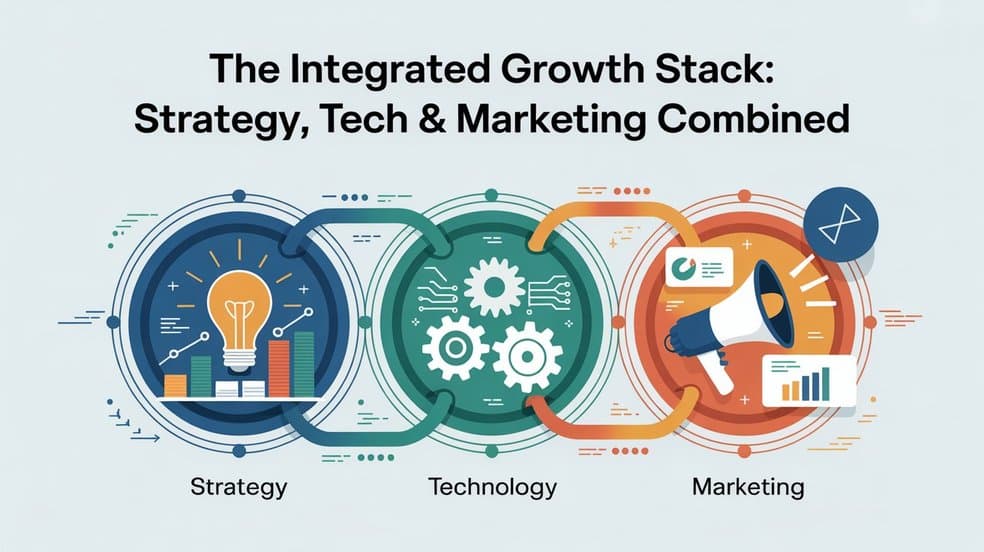
Strategy is direction, technology makes it happen, marketing spreads the word but ultimately growth takes place when they all seem like one system. There are no gaps between planning and performance anymore when the system is integrated. This makes faster progress much easier.
Integrated growth stack - Insights fit into systems, systems support execution, and execution fuels strategy. Companies that combine information, process and execution in such a way are more able to adapt, grow and stay consistent through all stages of growth.
How Aventus Builds the Integrated Growth Stack
At Aventus, growth is approached as an interconnected ecosystem rather than a collection of individual services. The process begins with strategic understanding, where market insights and business intelligence shape clear growth direction. This foundation guides technology development, ensuring that digital platforms and operational systems directly support organizational goals instead of existing as standalone solutions.
Once strategic clarity and technological capability are established, marketing execution activates growth in the real market. Brand positioning, digital experiences, and communication strategies are aligned with both business objectives and system capabilities, creating continuity between internal operations and external engagement.
By combining strategy, technology, and marketing into one cohesive framework, Aventus enables organizations to move beyond fragmented execution and adopt a structured approach to sustainable growth. The result is not simply improved performance in individual areas but a unified growth engine designed for long-term impact.