


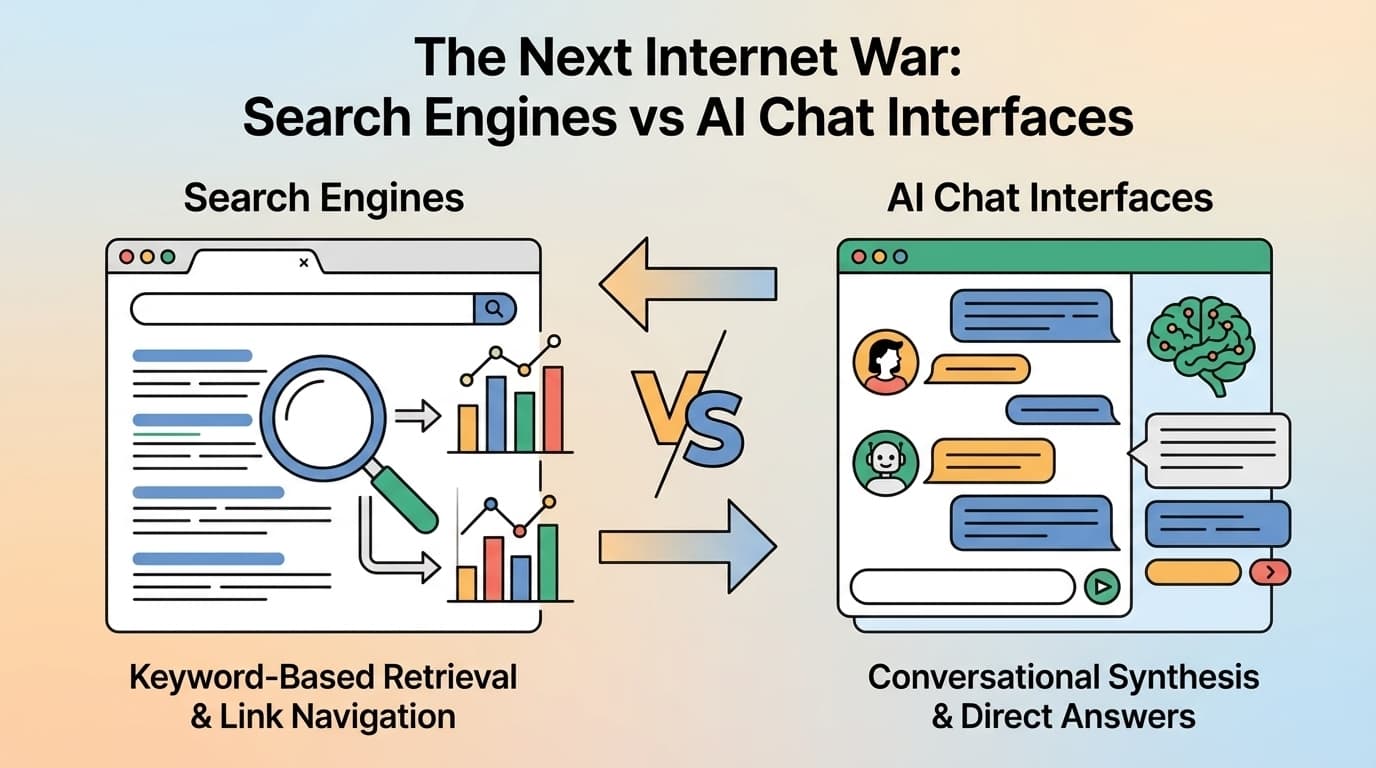
For more than two decades, search engines have been the primary gateway to the internet. When people needed information, they typed a query, scanned through links, and chose which website to visit. Companies like Google built massive ecosystems around this behavior, turning search into one of the most powerful business models in the digital economy.
But a new challenger is rapidly changing how people interact with information: AI chat interfaces.
Platforms like ChatGPT, Claude AI, and Perplexity AI are shifting the internet experience from searching for answers to directly receiving them. Instead of browsing through multiple links, users can simply ask a question and receive a summarized, conversational response in seconds.
This change may seem small, but it represents a fundamental shift in how information flows across the internet.
From Link Discovery to Answer Delivery
Traditional search engines operate on a discovery model. When someone searches for something, the engine presents a ranked list of links. Users then decide which websites to visit, compare sources, and gather information.
AI chat interfaces operate differently. They aim to synthesize information and present a direct answer. Instead of ten blue links, users receive a single response that aggregates knowledge from multiple sources.
This changes the role of websites themselves. If users no longer need to visit multiple pages to gather information, traffic patterns across the web could shift dramatically.
The Battle for the Internet’s Front Door
Search engines have long controlled what many call the “front door of the internet.” Billions of daily searches determine which websites receive visibility, traffic, and revenue.
Now AI platforms are competing for that same role.
Companies like Microsoft have integrated AI deeply into search through tools like Microsoft Copilot, while Google has responded with its own AI-powered search experiences such as Google Gemini.
Meanwhile, standalone AI answer engines such as Perplexity AI are positioning themselves as the next generation of search, combining conversational responses with cited sources.
This competition is not just about technology; it is about control over information access.
A New Economy of Attention
The rise of AI chat interfaces also raises major questions about the digital economy.
Search engines rely heavily on advertising. Sponsored results, paid placements, and search ads generate billions of dollars annually. But conversational AI interfaces operate differently. If users receive answers directly, there may be fewer opportunities to display traditional ads.
This forces companies to rethink how information platforms generate revenue. Subscription models, AI-powered recommendations, and new forms of contextual advertising may become more important.
The Impact on Businesses and Content Creators
For businesses, marketers, and publishers, this shift could be profound.
Search engine optimization (SEO) has been a core strategy for gaining visibility online. Entire industries exist to help companies rank higher in search results. But if users begin relying more on AI-generated answers, visibility may depend less on ranking pages and more on becoming a trusted source for AI systems.
Content strategies may evolve toward authority, structured knowledge, and credible data sources that AI systems rely on when generating responses.
The Hybrid Future
Despite the growing competition, the future may not be a simple replacement of search engines by AI chat interfaces.
Search remains powerful for discovery, exploration, and navigating the web. AI chat interfaces excel at summarizing, explaining, and guiding users through complex questions.
The most likely outcome is a hybrid model, where search engines and AI assistants merge. Users may still search for topics, but AI will increasingly interpret queries, summarize results, and guide decision-making.
A Structural Shift in the Internet
The real story is not whether search engines or AI chat interfaces will win. The deeper shift is how humans interact with information online.
For years, the internet was organized around finding pages. The emerging model is organized around understanding answers.
The companies that succeed in this new environment will not simply index the web. They will interpret it, contextualize it, and deliver knowledge in real time. And that is why the next internet war will not just be about better algorithms. It will be about who becomes the primary interface between humans and the world’s information.