


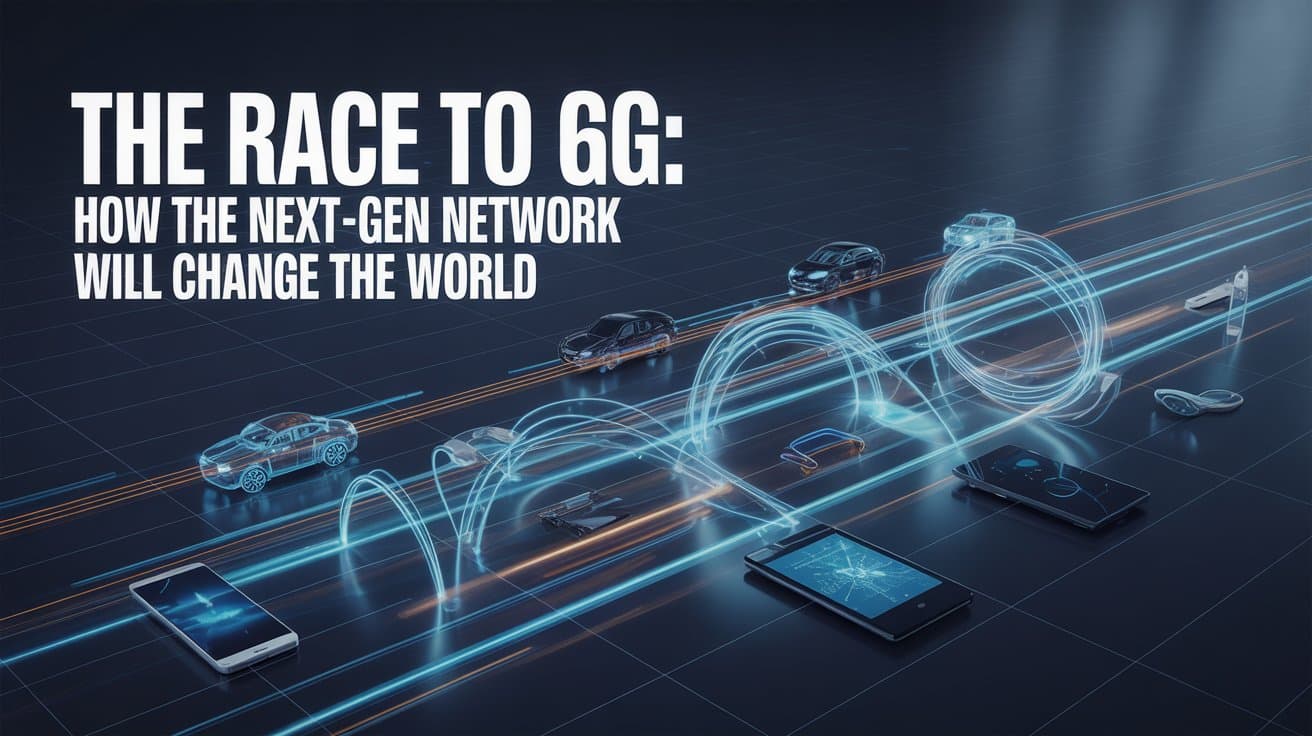
The telecommunications industry is focused on innovating and next iteration of network technologies. As 5G continues to change the way we connect, experts and industry leaders are already discussing what's next: the 6G era, which could have implications for how we connect in the future. 6G will offer greater network availability, faster speeds, and ultra-low latency, enabling technologies that are beyond our imagination today.In this blog post, we’ll explore the technological advancements required to make 6G a reality, examine its potential impact on consumers, and analyze the key companies and industry players driving its development. Buckle in for an exciting ride into the future of connectivity.
What is 6G and How Will it Impact Our World?
6G is the future of wireless communication that will be capable of data transfers at a rate that is up to 100 times faster than 5G. With the help of advanced artificial intelligence (AI) and machine learning, 6G networks will be able to deliver uninterrupted connectivity thereby making it possible for devices to function as a single unit even if you happens to be in a crowded city or the furthest off place. This revolutionary technology is geared towards a highly interconnected, intelligent, and self-regulating ecosystem. The list of 6G applications includes ultra-high-definition streaming, real time virtual reality, and fully autonomous vehicles. The 6G network is the one to break the barriers.
How Does 6G Differ from 5G?
With every new generation of mobile technology, the speeds get higher, the latency gets lower, and the connectivity gets stronger. At a latency as low as one millisecond, 5G is already facilitating high-speed data transfers of up to 20 Gbps, in such a way that a download will be finished in a blink of an eye while a gaming session will be seamlessly smooth.
6G technology is expected to be up to five times faster than 5G, with data speeds that could reach 100 Gbps and even up to 1,000 Gbps (one terabit per second). Latency the time required for data to travel could fall to as low as 0.1 milliseconds, enabling near-instant communication with almost no perceptible delay.
In addition, thanks to the upcoming 6G technology, the Internet of Things (IoT) will be able to operate at a whole new level, having the capability to link up in real time billions of appliances and gadgets. The effects of this will be the arrival of smart cities, self-driving cars, and AI that changes users’ habits with the speed of light.
Why 6G Isn’t Just Faster, It’s Smarter
6G is expected to change completely the manner we live and connect. With extremely high speeds and near-zero latency, 6G will enable seamless real-time communication and uninterrupted data sharing. Smart cities, self-driving cars, and remote healthcare will be some of the applications of this technology, all powered by real-time data. Besides, it will facilitate the incorporation of AI, hence devices will be able to take quicker and more intelligent decisions. Clients will benefit from improved device performance, more reliable connectivity, and endless possibilities for creativity across sectors such as education, entertainment, manufacturing, and transportation.
Challenges on the Road to 6G
Although 6G is full of potential, it is far from simple to get there. The necessary infrastructure to support it will require costly investments and cooperation worldwide. Challenges regarding data security, privacy, and energy consumption will always be there. In addition, it will take time to come up with new devices and standards that are capable of such high speeds. The 6G dream will become true only if governments, tech companies and researchers coordinate their efforts to solve these problems in a proper way.
Future scope of 6G networks
About a decade back, people referred to the term "Beyond 4G" (B4G) as a possible concept that may follow 4G. At that time, 5G was still in the process of being developed. Now, we use the term "Beyond 5G" which is a sign for the future of 6G.
6G is going to be a technology that will come after 5G i.e. it will be faster with more intelligent devices and stronger connections. It will produce a mesh of interconnected networks that will be able to reach the areas where the old cell towers are not.
In order to do this, data centers will be able to use extremely advanced and smart AI, edge computing, and even quantum technology tools. Artificial intelligence in 6G will be the main feature that helps the networks to be able to think, learn and even respond without delay.
Conclusion: 6G Transforming Life as We Know It
While 5G continues to enhance our digital world, 6G is geared to elevate connectivity to an entirely different realm. Some of the things it could do include making virtual meetings indistinguishable from real ones, allowing instant health monitoring, and supplying the energy to self-thinking smart cities.
6G is not only about faster speeds it is more about the technology being integrated into life so naturally that you hardly notice it. Yes, there are issues such as infrastructure and privacy, but the potential is limitless. We are moving towards a time when technology from the future becomes the present and the planet gets interconnected in an unprecedented way.