


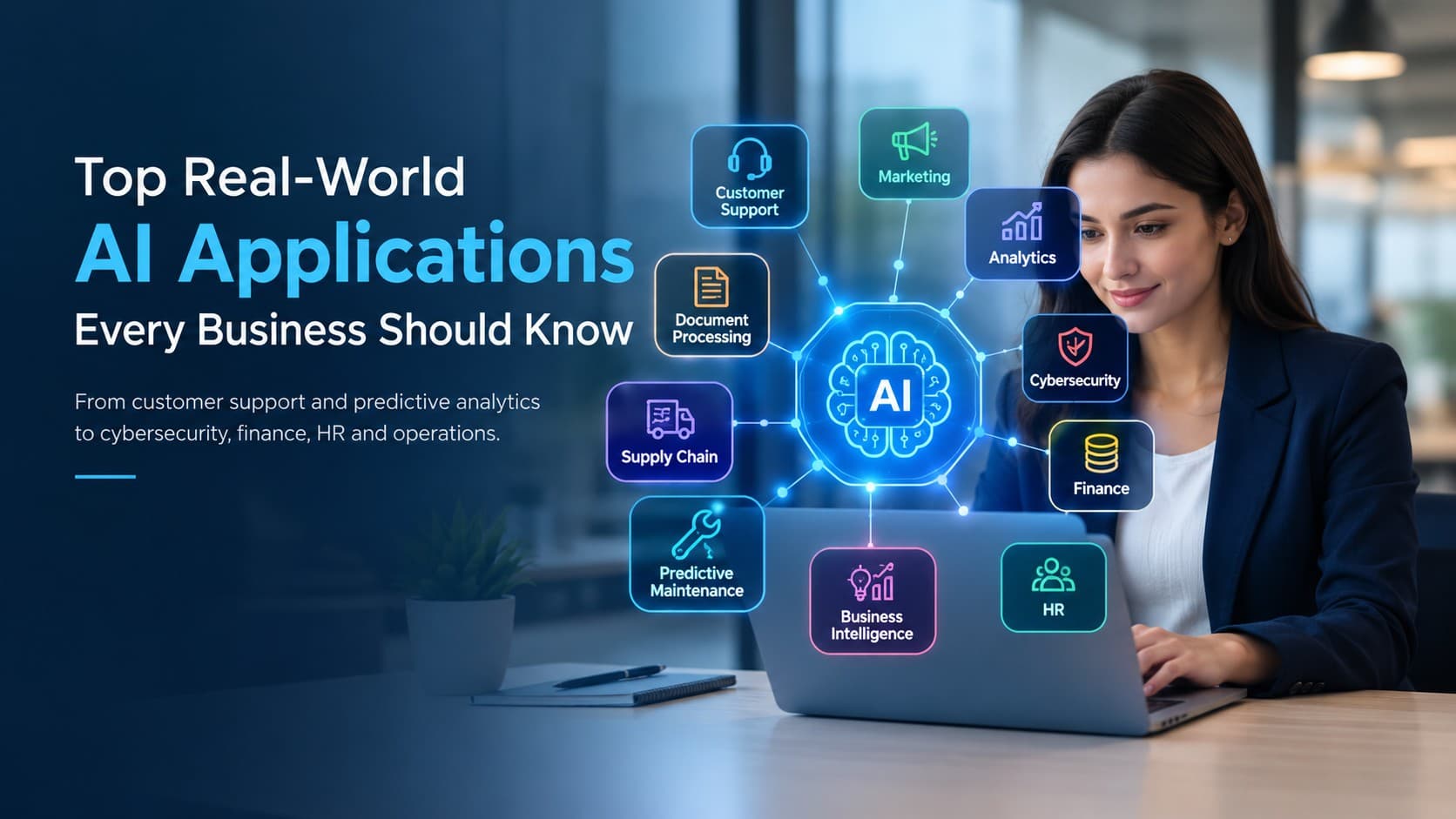
Artificial Intelligence (AI) has moved beyond being a futuristic concept to becoming an essential business tool. Organizations across industries are leveraging AI to automate operations, improve customer experiences, and make faster, data-driven decisions. Whether you're a startup or a large enterprise, understanding how AI is being used in the real world can help you identify opportunities for innovation and growth.
Here are ten practical AI applications that are transforming businesses today.
1. Intelligent Customer Support
Using AI-powered chatbots and virtual assistants in customer service is changing the way customers are helped by making available instant, 24-hours-a-day assistance. These virtual assistants can handle FAQs, fix common problems, and escalate difficult questions to human agents if needed. Such a solution not only contributes to faster responses but also leads to higher customer satisfaction and reduction in company expenses.
2. Personalized Marketing
AI gives companies the capability to offer customers a very individualized experience by studying their behavior, preferences and previous purchases. Using AI, businesses can roll out accurate product recommendations or design precise marketing campaigns that will directly attract customers with relevant content thereby increase the rate of potential buyers and even develop a customer base that expresses loyalty over the time.
3. Predictive Analytics
Every day, businesses produce a huge amount of data, with the help of AI, and they are able to extract meaningful insights from such data. Predictive analytics takes past as well as present data to do the forecasting of customer demand, detecting of market trends, and anticipating the potential risks. That's why, the companies will be able to take the lead by making their decisions in a proactive manner rather than just reacting to the changes in the environment.
4. Automated Document Processing
Processing invoices, contracts, forms, and reports can be time-consuming and prone to human error. Artificial intelligence can take over these jobs by accurately extracting, classifying, and validating the information in the documents. So, companies can increase their work speed and at the same time decrease their paperwork.
5. Fraud Detection and Cybersecurity
The role of AI in safeguarding businesses from fraud and cyber threats cannot be overstated. AI systems are designed to monitor transactions and user behavior incessantly and can swiftly identify irregular activities that might be security threats. As a result, it becomes possible for companies to act more promptly, reduce their financial loss, and enhance their security measures simultaneously.
6. Supply Chain Optimization
Inventory and logistics management have been made more efficient via AI-assisted demand forecasting and planning techniques. Predicting demand, calculating the most economical stock levels, detecting supply chain disruptions, and improving delivery timings are some of the ways AI supports companies. This leads to significant savings in expenses and the supply chain becomes durable enough to withstand even the most unexpected disruptions.
7. AI in Human Resources
Human resource departments are increasingly using AI to streamline recruitment and employee management. AI can help HR by going through resumes, picking out the best candidates, organizing interviews, and even helping new hires get acquainted with the organization. Besides, with AI, the company can get a deeper understanding of work trends and take steps to enhance staff motivation and reduce turnover.
8. Financial Management
Artificial intelligence is changing finance by automating tasks such as bookkeeping, expense management, financial reporting, and forecasting. Besides detecting irregularities in financial data, it can also increase precision, give important insights which, in turn, reinforce strategic planning and lead to more efficient financial decision-making.
9. Predictive Maintenance
Manufacturing and industrial companies leverage AI solutions to track machinery performance as well as schedule maintenance activities before breakdowns. By analyzing sensor data in real time, AI helps reduce downtime, lower maintenance costs, and extend the lifespan of critical machinery.
10. Business Intelligence
Today, business intelligence systems use AI to work through complicated data and discover significant trends. Business managers no longer need to spend long hours understanding reports; they can get insights almost instantly, which help them to make decisions more quickly and accurately in sales, operations, and strategy.
Conclusion
Artificial Intelligence is no longer a competitive advantage reserved for a few, it's becoming a business necessity. Organizations that combine AI with human expertise, strategic thinking, and continuous innovation will be better positioned to adapt, compete, and grow in an increasingly digital economy.
While AI is already transforming customer service, finance, operations, and analytics, its influence extends even further into the way organizations make decisions. As businesses increasingly rely on AI-driven insights, leaders must also understand the balance between automation and human judgment. For a deeper perspective, read our article, "Is AI Quietly Taking Over Human Decision-Making?"
The future of business is not just digital, it's intelligent.