


She seems like someone you know, right? Her gentle freckles, the lovely natural waves in her hair, the pattern on the dress, the warmth of the dried flowers spread around her…all these things are so natural, beautiful, almost like a real-life photograph. She is the kind of person whose existence is doubted, yet it turns out to be real – as if someone interrupted her thought in the middle, she is surrounded by nature and she doesn’t know that a photo is being taken.
However, this is the paradox:
She is not real. We did not see her made up, or photographed, or staged. No one decorated her features. No photographer changed the lighting or the framing. There was no moodboard, no retakes, no editing suite. She is a concept made real- an artificial intelligence creation with the accuracy of a professional beauty photographer and the aesthetic choice of a fashionable editorial shoot.
And that’s where the conversation begins.
Because today, especially in beauty, fashion, and advertising, AI-generated faces like hers are no longer rare, they’re becoming the norm. They’re flawless, adaptable, timeless, and endlessly scalable. Brands can create models without budgets, without physical photoshoots, and without the constraints of reality.
But as these perfectly crafted digital humans multiply across posters, product packaging, and campaigns, one question becomes impossible to ignore:
When everything looks real but nothing actually is, are we losing authenticity, or redefining what authenticity means?
The Homogenisation of Visual Creativity
In the past, advertising was all about surprises, surprising compositions, surprising narratives, surprising mistakes, and some degree of cultural experimentation. Today, AI-based imagery dominates posters, campaigns, and ads that are digitally-based, many using the same visual language. Everything is clean, symmetrical, shiny, cinematic...and disturbingly the same. AI-based tools have undoubtedly increased the pace and accessibility of visual production, but the landscape now threatens to have every brand being very similar to each other rather than disparate. In search of efficiency, we have unintentionally created an aesthetic monoculture.
Tech or Threat? The Mixed Reality of AI-Generated Art
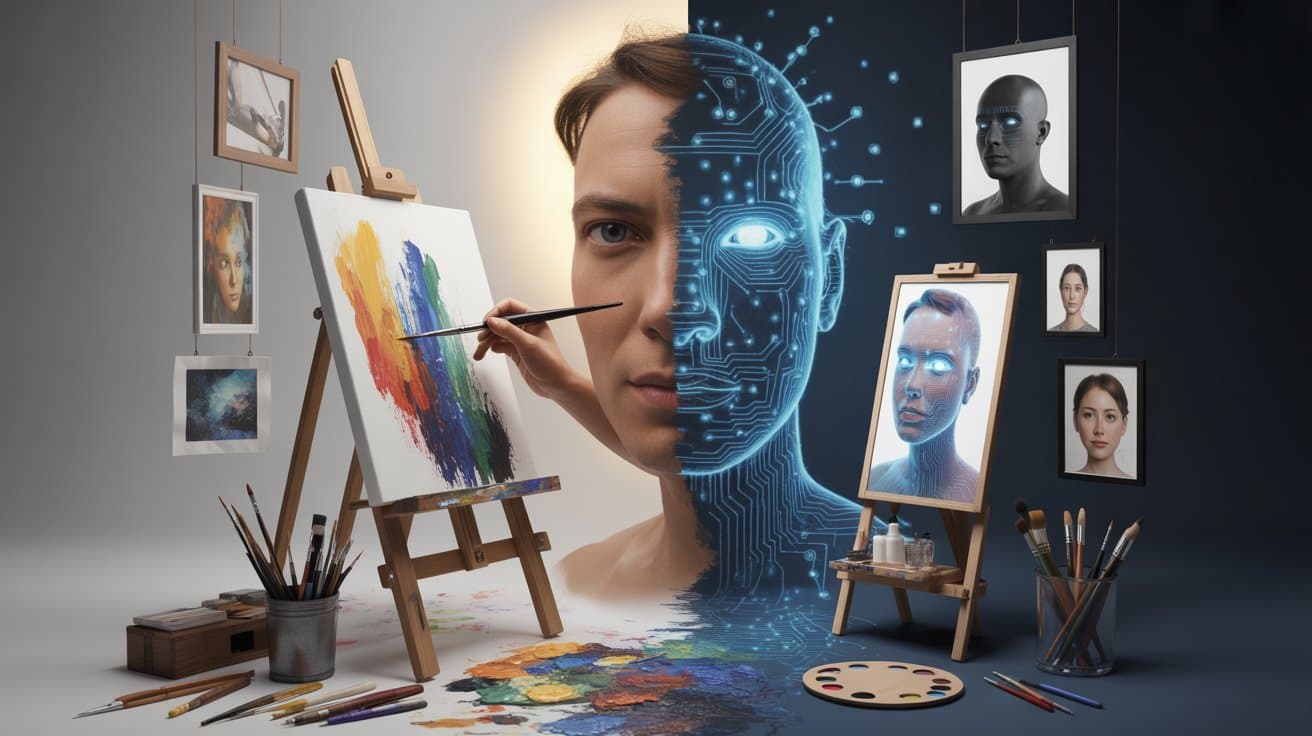
AI art sits in an interesting space between innovation and controversy. On one hand, it’s an incredibly powerful tool that can help anyone brainstorm visual ideas, test layouts, experiment with colour, and overcome creative blocks almost instantly. It makes design more accessible, especially for people without formal artistic training, and can speed up workflows that would traditionally take hours. But alongside the excitement comes a growing set of concerns. AI-generated visuals often lack the emotional depth, imperfections, and personal fingerprint that give hand-made art its resonance. The technology also tends to rely on existing patterns and popular aesthetics, resulting in repetitive, predictable styles rather than bold creative breakthroughs. Beyond the visual output, there are ethical and environmental questions from copyright and credit to the energy required to train large models. And as AI becomes easier to use, some worry that the craft, effort, and journey behind making art may be undervalued. Ultimately, AI works best not as a replacement for creativity but as a supportive tool one that can spark ideas and speed up execution, while the true originality still comes from the human guiding it.
Are We Losing Originality? Not Quite.
Artificial intelligence is not the problem, rather the way we use it is problematic. When all people choose to work with the same models, prompt styles, presets, and aesthetic references, then it is a matter of time before the identical results become obvious. However, originality is now found in a different place - not in the device but in the user's intention. A creative person who manipulates, alters, experiments, combines different mediums, or takes AI beyond standard patterns is not simply producing a visual - they are expressing their perspective. AI doesn’t erase creativity; it shifts where creativity happens.
AI as the New Photography?
When digital cameras and Photoshop came into the picture, a lot of people were worried about the end of photography and design crafstmanship. However, those tools didn't substitute creativity, they actually broadened it. The change is similar with AI now. The company is not getting rid of positions; it is changing the nature of the jobs. Just like photography evolved from film to digital to computational, visual communication is now transitioning from manual execution to conceptual direction.
So, Are We Losing Originality or Redefining It?
We are not losing originality; rather, we are re-questioning the source of it. Designers are changing their roles from being the creators of visuals to the curators of meaning, the directors of style, and the interpreters of culture. With AI, almost anything can be made to look beautiful - hence the new challenge is not execution but distinction. In a world full of perfectly generated images, standing out requires perspective, courage, and a willingness to go beyond what the algorithm expects.
It’s not about whether AI will replace originality, the real issue is whether we, as creators, are willing to push beyond predictable AI outputs and make decisions that reflect true human thought, emotion, taste, and imagination.
So, here’s a question for you: when you pause and look at an AI-generated face, are you admiring creativity or believing in something that isn’t there?share your thoughts with us.