


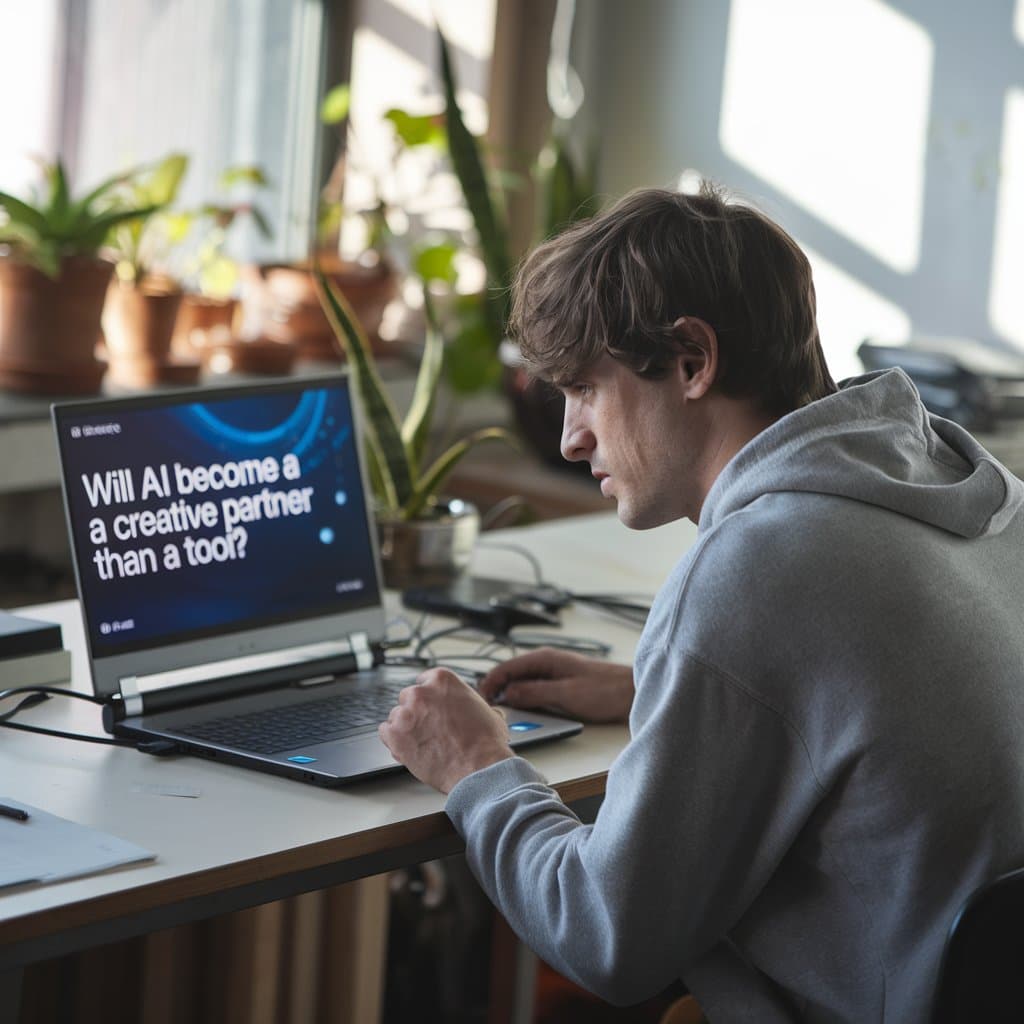
Artificial Intelligence has advanced tremendously within the past few years, altering whole industries and changing our way of living and working. From simple task automation to analytic insights on huge datasets, AI has proved to be a potent asset. As AI continues its progress, a very interesting question remains- is it capable of going beyond being merely a tool; can it become a real creative collaborator?
The Current Role of AI in Creativity
AI can analyze vast databases and propose diverse concepts that would be nourishing enough for an artist's next masterpiece. It also tends to create surprising connections leading to them igniting their inner flame.
Visual artists can take on either part of AI-generated images as the foundation for new creations. AI algorithms can generate abstract patterns, transform images, or originate distinct compositions to be used by the artist within their works.
Musicians can explore what AI does to generate melodies harmonies and even entire compositions. By studying the existing works, AI will produce an original musical concept, allowing artists to explore new genres and styles.
Writers and poets have AI-generated prompts inspiring them. AI can provide sentences, ideas, or full paragraphs as a foundation for developing captivating stories.
What Does It Mean to Be a Creative Partner?
For AI to be seen as a creative partner, there must be a shift away from pure functionality toward a stage of collaboration in which it contributes original ideas and reacts to context, emotional, and cultural nuances. A creative partner is not just going by the rules, it is actively involved, surprising and testing the creative human designers to conceive a fresh way of thinking.
The Signs of Evolution
Adaptive Creativity: Contemporary AI systems such as ChatGPT and MidJourney are capable of producing high-quality content, contextually apt, and adaptive. They can capture feedback and tweak their outputs, thereby imitating the iterative creativity of human beings.
Idea Generation: AI is increasingly favored for brainstorming ideas. For example, marketers use AI to brainstorm innovative campaign concepts, and architects use generative design algorithms to create novel buildings.
Collaborative Learning: A few AIs are already learning in real-time from human counterparts. This iterative learning gives rise to a dynamic dialogue such that AI and humans have a reciprocal exchange and push each other toward new limits.
AI-Powered Tools and Applications For Creativity
With the advent of AI, the new toolset and applications are changing the creative workflow. These tools take advantage of the power of AI to enhance user creativity and facilitate workflows, which in turn leads to increased speed and efficiency for creative practitioners.
Such a tool is DeepDream, created by a Google developer. DeepDream applies artificial intelligence algorithms to analyze and reshape images, achieving dreamlike, out-of-the-ordinary images. It enables artists to experiment with new visual aesthetics and produce aesthetically unique, even striking works.
Another artificial intelligence(AI)-based tool in the market that is becoming more popular is Adobe Sensei. Sensei is an AI toolkit created by Adobe and embedded within their creative software suite (Photoshop and Illustrator). Sensei employs AI algorithms to automate trivial, object-or-background-selection-based work, enabling creative professionals to devote themselves to higher-level creative work.
On top of these tools, AI is also employed to improve the user experience in creative applications. For example, AI algorithms can learn from a user's behavior and preference to tailor the innovative software interface to be more intuitive and user-friendly.
Is AI a True Partner? - A Debate
On the one hand, it can be claimed that AI can make the creative process better by offering new instruments and potentialities, which allow the creatives to discover new paths and come out of the conventional limits of their creativity. AI algorithms can produce knowledge from big data sets that humans are unable to discover alone. It may result in new inventions, joyful accidents, and the breakthroughs in creative process, which is a leap forward in innovation capabilities.
On the other side of the coin, the application of AI in creative tasks foresees the risk of human creativity and originality being disenfranchised. Although AI algorithms can create new content, there is an ongoing discussion over whether AI is creative in the same sense that humans are. Some argue that AI can do nothing more than reproduce human creativity, and no more richness and complexity of the human condition. However, some people think that AI could go beyond humankind's inspiration and generate entirely new artistic and expressive forms.
The Human-AI Symbiosis
Instead of being afraid of the impact of artificial intelligence on creativity, we should welcome the opportunity for a symbiotic relationship. What humans can provide is emotional intelligence, cultural sensitivity, and ethical thinking, whereas AI can provide speed, accuracy, and mass data processing. As a unit, they may make creative innovations that could not be made one by one.
This symbiosis between humans and AI can reshape the boundaries of creativity. Combining human insight and intuition with AI's capacity to process great amounts of data and figure out patterns, we can take a shot at complex problems with unprecedented accuracy and nuance. In this collaboration, humans are the futurists and to give AI an ethical lens and a cultural touch, it will become a speed booster that materializes the vision of the futurists. As a combined pair, they are a dynamic duo and able to provide creative innovations which, individually, they could not accomplish.
Conclusion
AI’s role in creativity is evolving rapidly. Although it may be a while still before artificial intelligence can be considered a true creative collaborator, the future is going down this path. By recognizing present deficiencies and encouraging teamwork between humans and machines, we can achieve a future in which AI is no longer a mere instrument, but a co-creator, a real collaborator toward the reach of creativity.