

The Initial Observation: When Work Becomes Difficult to Track
As organizations scale, operational complexity increases quietly. Teams begin managing multiple clients, parallel projects, internal requests, and unexpected issues simultaneously. What initially starts as manageable coordination gradually evolves into fragmented communication, missed deadlines, and reduced visibility across teams.
Many organizations rely on emails, messaging tools, or disconnected tracking sheets to manage work requests. While these methods function temporarily, they often lack structure, accountability, and centralized oversight. Managers struggle to understand project status, teams lose clarity on priorities, and critical tasks risk being delayed without timely intervention.
At Aventus, this recurring operational challenge was observed across multiple internal and client environments. The problem was not a lack of effort or expertise, it was the absence of a unified system capable of organizing work intelligently.
This insight led to the creation of a centralized Ticketing System designed to transform how teams manage tasks, issues, and collaborative workflows.
Rethinking Ticketing as an Operational Framework
Traditional ticketing tools often focus narrowly on issue reporting or customer support workflows. However, modern organizations require something broader, a system that supports structured collaboration across departments, projects, and stakeholders.
The vision behind the platform was therefore not simply to track tickets, but to establish operational clarity. Every task, request, or issue needed to exist within a defined structure where ownership, timelines, and priorities were transparent to everyone involved.
At Aventus, the system was conceptualized as a shared operational environment where teams could move from reactive task handling to proactive work management. Each ticket became more than a record of work; it became a unit of accountability connected to organizational processes.
Master-level configurations were introduced to standardize ticket categories, priorities, and statuses, ensuring consistency across projects while reducing administrative ambiguity. This approach allowed teams to operate within clearly defined workflows without sacrificing flexibility.
Aventus’ Role: Designing Intelligence Into Everyday Workflows
Aventus developed the platform from the ground up, focusing first on understanding how real teams collaborate rather than replicating existing ticketing models.
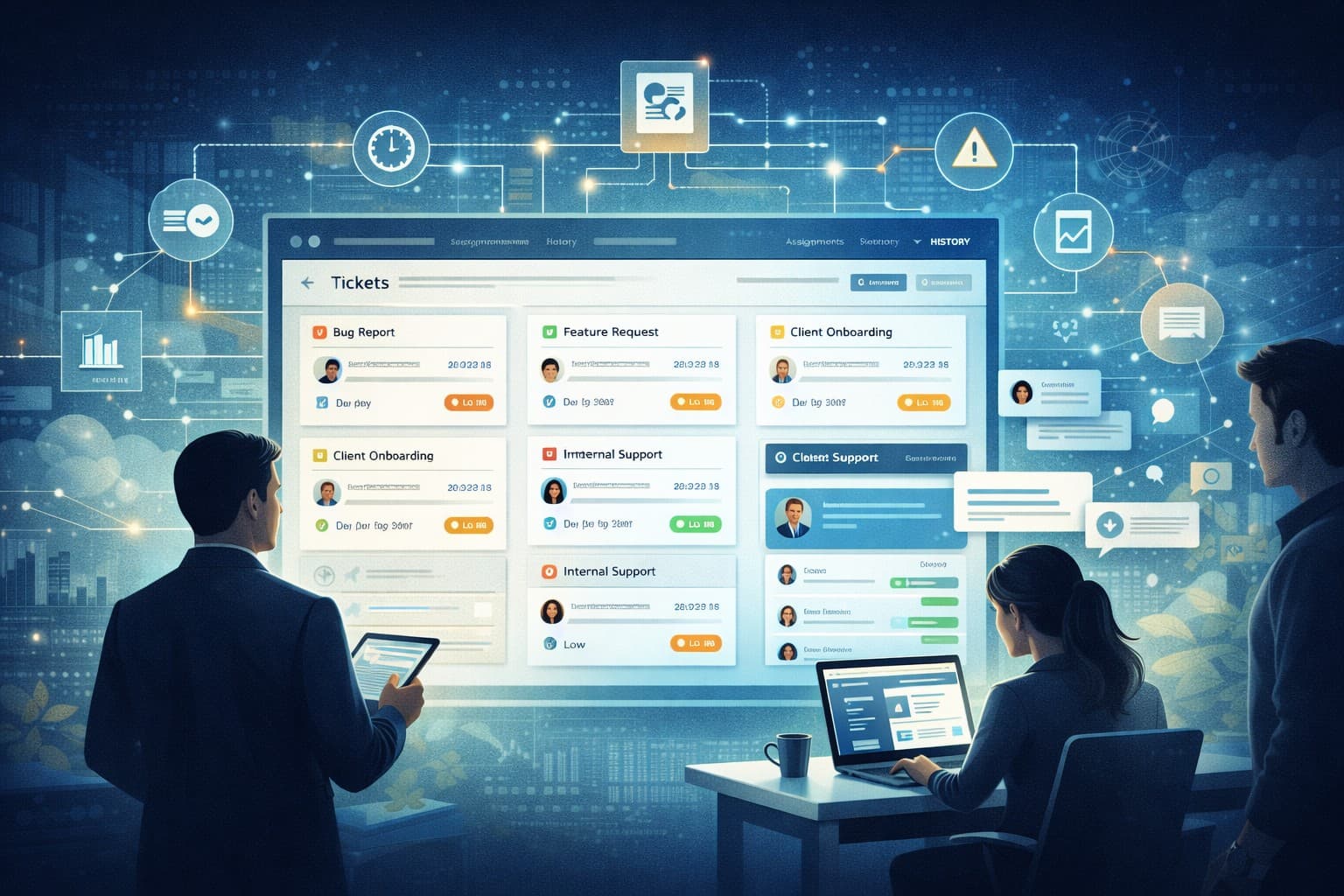
The system architecture was designed to support structured assignment and ownership. Tickets can be allocated to users with clearly defined responsibilities, while due dates can be set manually or generated automatically based on predefined resolution timelines. This automation ensures that urgency is embedded directly into the workflow rather than dependent on manual follow-ups.
One of the defining elements introduced by Aventus was intelligent escalation logic. Instead of relying solely on human monitoring, the platform actively tracks approaching deadlines and automatically notifies the appropriate stakeholders when action is required. This shift transforms management from reactive supervision into proactive governance.
Collaboration capabilities were also deeply integrated into the system. Teams can communicate directly within tickets through comments, summaries, review notes, bug tracking updates, and subtasks, allowing discussions and execution to remain connected within a single operational context.
Through these design decisions, Aventus positioned the Ticketing System not as a monitoring tool but as a digital coordination engine supporting modern team dynamics.
Designing for Transparency and Accountability
As development progressed, visibility became a central design principle. Organizations needed the ability to understand not only what work existed but how it progressed over time.
The platform therefore provides comprehensive activity tracking, enabling teams and managers to review ticket history, workflow changes, and user interactions. Time tracking capabilities allow organizations to measure effort distribution, monitor productivity patterns, and gain deeper insight into project execution.
Rather than creating additional administrative burden, the system captures operational data naturally through everyday usage. Teams simply perform their work while the platform builds a transparent record of progress and performance.
This visibility strengthens accountability while reducing dependency on manual reporting, allowing leadership to make informed decisions based on real operational signals.
Building a Scalable Foundation for Growing Organizations
Operational tools must evolve alongside organizational growth. As teams expand, projects diversify, and workflows become more complex, systems must support increasing scale without introducing friction.
Aventus engineered the Ticketing System as a scalable platform capable of supporting multiple clients, varied project structures, and evolving process requirements. The modular design allows organizations to configure workflows according to their operational model while maintaining centralized governance.
Performance optimization ensures that large volumes of tickets, collaborative interactions, and activity tracking remain efficient and responsive. This future-ready foundation allows the system to grow alongside business operations rather than requiring replacement as complexity increases.
Impact: From Task Tracking to Operational Intelligence
The introduction of the Ticketing System fundamentally changed how work is organized and executed within teams.
What was once managed through scattered communication channels evolved into a centralized environment where every task carries context, ownership, and measurable progress. Teams gain clarity on priorities, managers obtain real-time operational visibility, and organizations reduce delays caused by miscommunication or overlooked responsibilities.
The platform transforms ticket management from a reactive administrative function into a strategic operational capability. By combining automation, collaboration, and transparency, the system enables organizations to operate with greater discipline and confidence.
Looking Ahead
As businesses continue to scale across distributed teams and complex project environments, structured work management will become increasingly essential. Organizations require systems that not only record work but actively support execution, collaboration, and accountability.
Through the design and development of this Ticketing System, Aventus demonstrated how thoughtful product engineering can transform everyday operational challenges into streamlined digital processes. The project reflects a broader philosophy, technology delivers its greatest value when it quietly organizes complexity, enabling teams to focus on outcomes rather than coordination.