


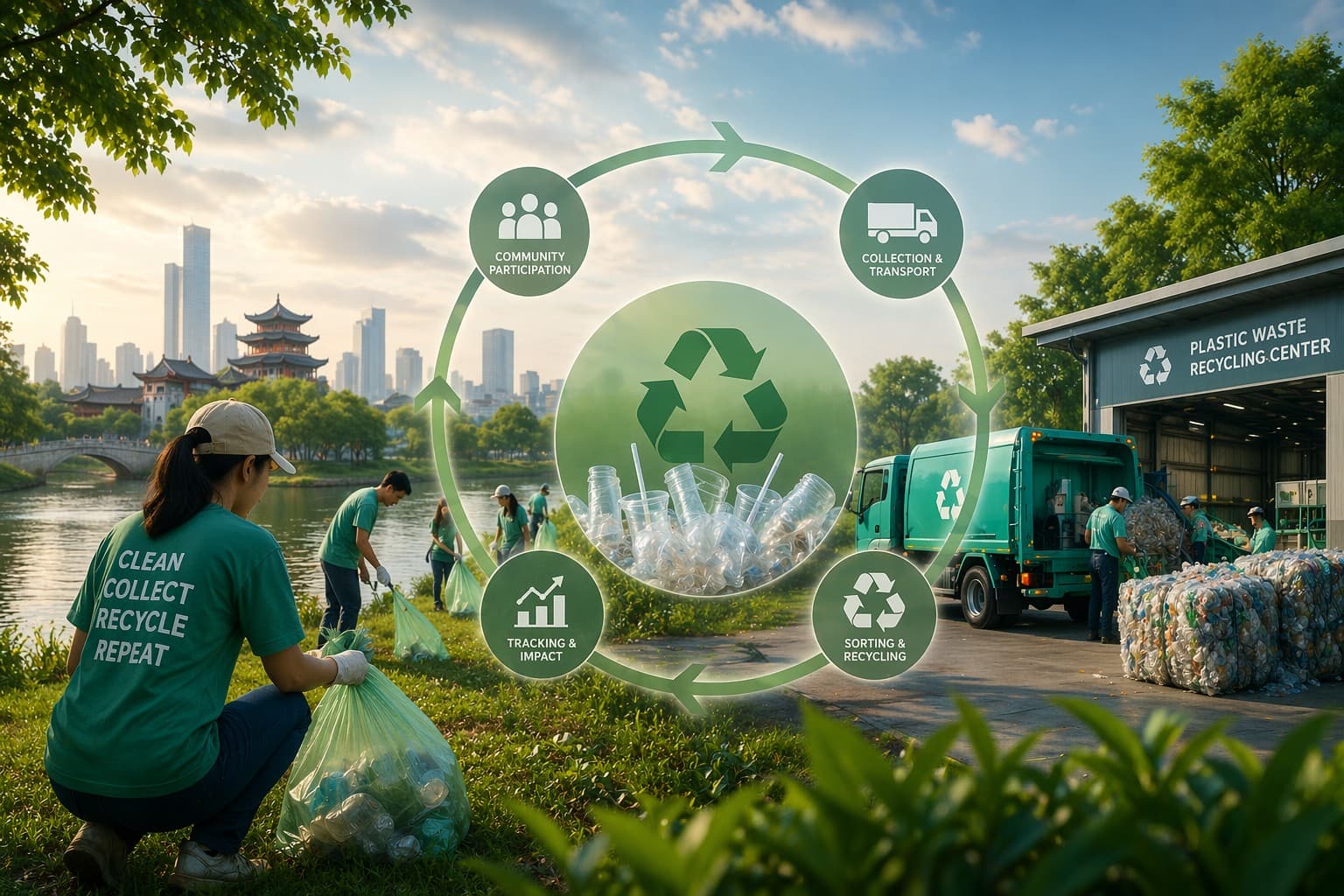
The Initial Observation: Plastic Consumption and the Urban Sustainability Challenge
Across rapidly urbanizing regions, sustainability challenges increasingly emerge not from lack of awareness but from fragmented systems. Cities experiencing growth in food delivery and takeaway consumption face a sharp rise in single-use plastic waste, particularly from food and beverage containers.
In Suzhou, this transformation reflected a broader global pattern: consumption models evolved faster than waste management infrastructure. While recycling initiatives existed, coordination across citizens, waste collectors, municipal actors, and recycling facilities remained limited.
The JingSu initiative was conceived to address this structural gap. Its ambition extended beyond clean-up campaigns; it sought to establish a functioning ecosystem capable of collecting, tracking, and recycling single-use plastic waste at scale. The initiative aimed to transform public participation into measurable environmental outcomes through systemized processes rather than isolated interventions.
Digital infrastructure became essential, not as a technology exercise, but as an organizing framework for collective environmental action.
Rethinking the Problem: From Awareness to System Design
Early sustainability programs often focused on behavioral change alone. However, project stakeholders recognized that awareness without operational continuity rarely produces lasting environmental impact.
The central insight guiding the initiative was clear: plastic waste management is fundamentally a coordination problem.
Waste moves through multiple invisible stages, generation, collection, aggregation, verification, transportation, and recycling. Without a unified system linking these stages, efforts remain fragmented and difficult to scale.
The project therefore reframed its challenge:
Not how to encourage participation alone,
But how to create a reliable circular workflow connecting citizens, campaigns, and recycling outcomes.
This required a digital environment capable of integrating community engagement with operational accountability.
Designing the Approach: A Digital Ecosystem for Circular Action
Rather than developing a conventional informational website, the platform was envisioned as an operational layer supporting the initiative’s environmental mission.
Working collaboratively with program stakeholders, Aventus translated sustainability objectives into a structured digital ecosystem. The design philosophy emphasized clarity, accessibility, and transparency, ensuring that environmental action could be understood and tracked by diverse participants.
The platform architecture reflected three interconnected principles:
Visibility: making plastic waste flows understandable to participants and organizers.
Participation: enabling community involvement through campaigns and activities.
Traceability: linking collected waste to verified recycling processes.
This systems-thinking approach ensured that digital infrastructure supported real-world environmental logistics rather than existing as a communication layer alone.
Development Through Collaboration: Aligning Environmental and Digital Thinking
The development process evolved through continuous dialogue between environmental practitioners, campaign organizers, and digital teams.
Instead of defining requirements solely at the outset, workflows were refined iteratively:
Campaign experiences were shaped around volunteer participation and community engagement.
Data structures were designed to support tracking of collected plastic waste.
Communication flows were aligned with public awareness objectives across social platforms.
Field activities, including clean-up campaigns that mobilized volunteers and generated public discussion, served as live testing environments for refining the platform’s functionality and usability.
Through this collaborative process, technology became a stabilizing force that connected environmental intent with operational execution.
Platform Implementation: Enabling Circular Waste Management
The resulting platform functions as a digital backbone supporting the JingSu initiative’s broader sustainability model.
Rather than presenting technology as a standalone product, the system enables coordinated environmental operations:
The platform organizes campaign information, educational resources, and participation pathways while supporting the tracking of collected waste through verified recycling channels. This creates continuity between community action and environmental outcomes.
Key capabilities emerged organically from the initiative’s needs:
Structured campaign coordination supporting public engagement.
Digital tracking connecting collection activities to waste treatment partners.
Knowledge-sharing resources encouraging behavioral change beyond individual events.
A scalable framework capable of expanding to additional locations or waste streams.
The platform thereby transforms episodic environmental action into a sustained circular process.
Impact and Outcomes: From Campaigns to System
The transformation achieved through the initiative lies less in technological novelty and more in institutional coherence.
Operationally, the platform strengthened coordination between volunteers, organizers, and waste management providers, ensuring that collected plastics entered formal recycling pathways rather than remaining symbolic actions.
Experientially, participants gained visibility into the environmental value of their contributions, reinforcing continued engagement.
Organizationally, the initiative moved closer to a scalable model for urban plastic waste management, one capable of evolving alongside changing consumption patterns.
By connecting awareness, participation, and recycling verification, the system helped convert environmental intention into measurable progress.
Looking Ahead: Digital Infrastructure as Environmental Governance
The JingSu Yangtze initiative illustrates a broader shift occurring across sustainability programs worldwide. Environmental impact increasingly depends not only on policy or activism but on the design of collaborative systems that align multiple actors around shared outcomes.
Digital platforms, when thoughtfully designed, become governance tools, enabling transparency, accountability, and long-term coordination.
Through this project, Aventus contributed as a strategic digital partner, translating an environmental vision into operational reality. By designing scalable systems, facilitating stakeholder collaboration, and embedding adaptability into the platform’s architecture, the work strengthened the initiative’s capacity for sustained impact.
As cities continue to confront the consequences of high-consumption lifestyles, projects like JingSu suggest that meaningful change will emerge not from isolated solutions but from carefully designed ecosystems where technology quietly enables collective responsibility.