


Understanding the Changing Landscape of Recruitment
Recruitment today operates at the intersection of technology, expectations, and speed. Organizations seek efficient ways to identify qualified talent, while job seekers navigate an overwhelming number of opportunities spread across multiple platforms.
Despite the growth of digital hiring tools, many recruitment systems still function as fragmented environments. Employers struggle with managing large volumes of applications, screening candidates efficiently, and maintaining meaningful engagement during hiring processes. At the same time, job seekers often experience uncertainty, submitting applications without visibility, feedback, or connection to recruiters.
This disconnect highlighted an important industry gap: hiring platforms were solving isolated problems rather than supporting the entire recruitment journey.
Xcruit emerged from this realization, not as a single application, but as a dual-platform hiring ecosystem designed to serve both sides of the employment relationship simultaneously.
Rethinking Recruitment as a Two-Sided Experience
The central idea behind Xcruit was simple yet transformative: recruitment works best when employers and candidates operate within connected digital environments designed for their distinct needs.
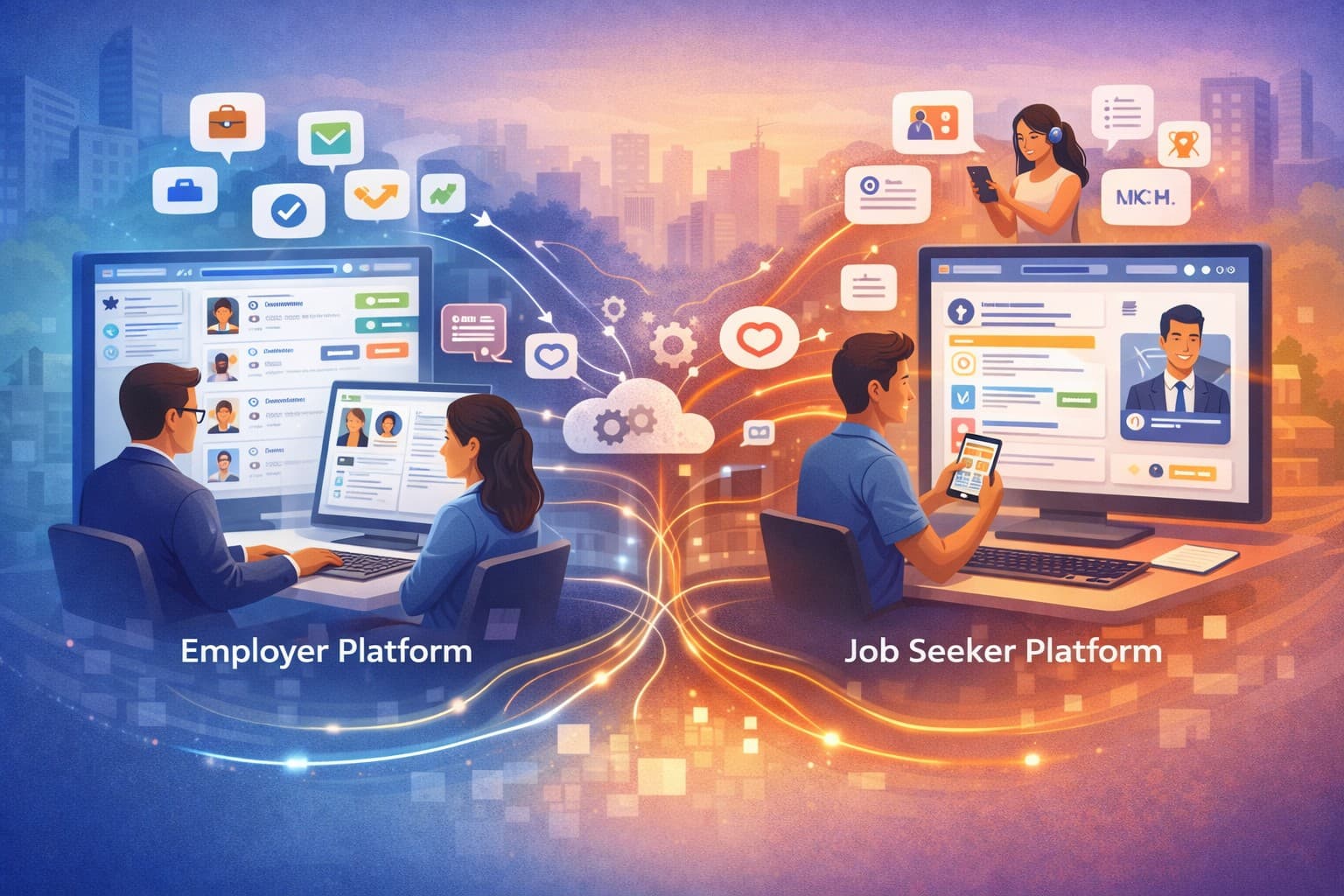
Instead of forcing both audiences into one generic system, Xcruit introduced two dedicated applications:
Xcruit for Employers, focused on simplifying recruitment management.
Xcruit for Jobseekers, designed to make career discovery more engaging, accessible, and empowering.
This separation allowed each platform to prioritize its users’ real workflows while remaining interconnected through shared technology.
For employers, recruitment needed to become faster, structured, and insight-driven. For job seekers, the experience needed to feel supportive, transparent, and motivating rather than transactional.
Designing Platforms Around Real Hiring Behaviour
The design philosophy behind Xcruit centered on usability and engagement.
The Employer App was structured as a practical hiring workspace. Organizations can receive applications, shortlist candidates, filter profiles based on qualifications and experience, review CVs and video resumes, and initiate interviews directly within the platform. Rather than relying on external tools or disconnected communication channels, employers manage recruitment through a single streamlined interface.
The Jobseeker App approached hiring from a different perspective. Recognizing that job searches can feel overwhelming, the platform introduces clarity and interaction into the process. Users can explore global job opportunities, create resumes quickly, and present themselves through video resumes, allowing personality, communication skills, and confidence to complement traditional credentials.
Features such as business quizzes and reward-driven engagement transform job searching from a passive activity into an interactive experience, encouraging continuous participation and learning.
At this stage, Aventus Informatics worked closely with the Xcruit team to translate this two-sided vision into a cohesive digital ecosystem. Aventus led the branding development, crafting an identity capable of resonating with both corporate employers and digitally native job seekers while maintaining consistency across markets.
Translating Vision into Scalable Technology
Building two interconnected applications required careful architectural planning. Each platform needed independent functionality while sharing a unified recruitment infrastructure.
Aventus designed and developed the mobile applications and web platform, ensuring seamless interaction between employers and candidates without compromising usability. The development process emphasized intuitive navigation, fast onboarding, and responsive performance, critical factors for users engaging with hiring tools daily.
Particular attention was given to simplifying complex recruitment actions. Employers could screen candidates efficiently through built-in filtering and evaluation tools, while job seekers experienced a smooth application journey supported by profile-building tools, global job access, and real-time support.
Through iterative development cycles, the platform evolved into a system where technology quietly supports decision-making rather than complicating it.
Creating Meaningful Connections in Hiring
The impact of Xcruit lies in how it reframes recruitment as a collaborative process rather than a one-sided transaction.
Employers gain improved visibility into candidate quality and hiring pipelines, reducing delays and administrative friction. The ability to review video resumes and conduct early-stage evaluations within the app allows organizations to understand candidates beyond written profiles.
For job seekers, the platform introduces agency and engagement. Career exploration becomes interactive, communication channels remain accessible, and the hiring journey feels more transparent and human-centered.
By aligning both experiences within one ecosystem, Xcruit strengthens the connection between opportunity and talent.
Looking Ahead
As workforce expectations continue to evolve, recruitment platforms must move beyond job listings toward environments that foster interaction, discovery, and informed decision-making.
Through its work in branding, mobile application development, and web platform engineering, Aventus contributed to shaping Xcruit into a scalable digital hiring ecosystem designed for modern employment dynamics.
Xcruit reflects a broader shift in recruitment thinking , one where employers and job seekers are supported through dedicated yet connected experiences, enabling hiring to become faster, more engaging, and more meaningful for everyone involved.