


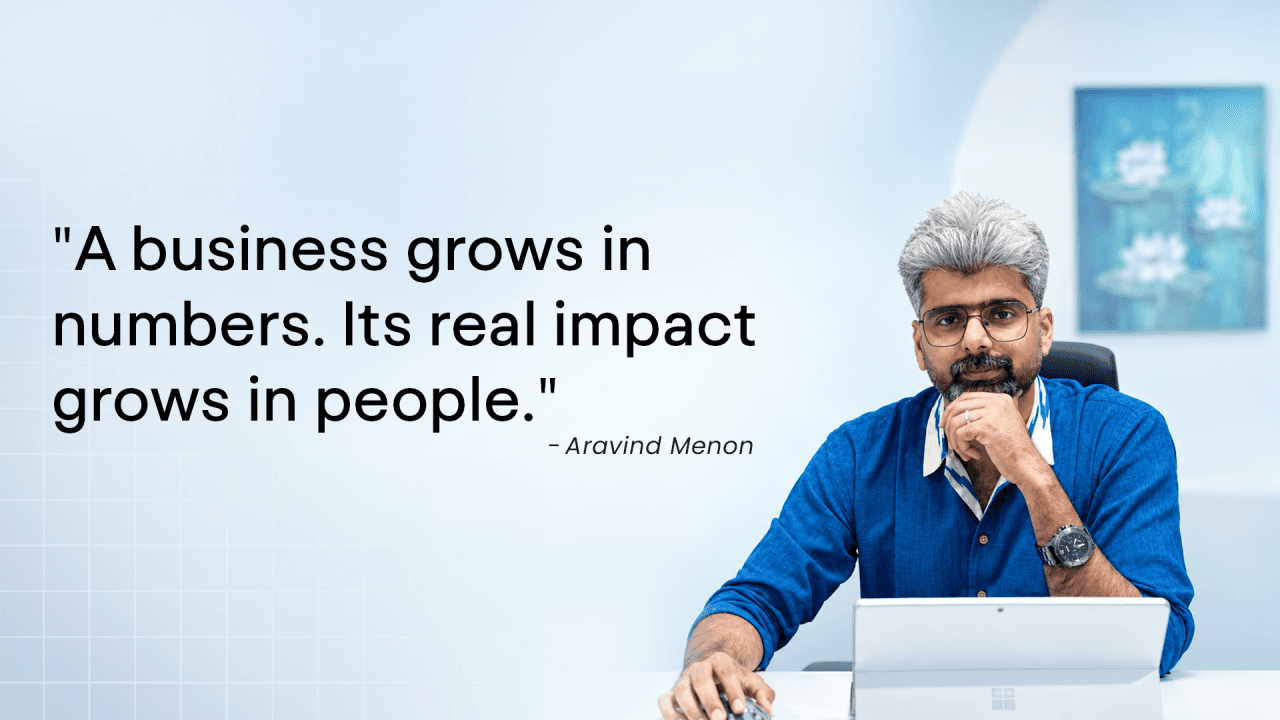
We spend a lot of time measuring businesses through numbers. Revenue, margins, growth, customer acquisition, productivity, valuation. Numbers are useful because they tell us whether something is working. But they also have a strange way of making a business look smaller than it really is.
A company may look like a collection of contracts, invoices, products and salaries on a spreadsheet. In reality, it is a collection of people trying to build lives.
That distinction becomes clearer as a company grows. A salary is not really a salary when you look beyond the bank statement. It is rent for one person, school fees for another, a medical bill somewhere else, groceries, a loan repayment, a parent's medicine, a child's weekend class, or simply the ability to say yes to something that was previously out of reach.
This is probably one of the least discussed parts of entrepreneurship. Founders spend enormous amounts of time thinking about how to create value for customers and shareholders. We talk about creating jobs as a consequence of growth, almost as if jobs are a line item that appears automatically when the business gets big enough. But there are real human beings sitting behind every one of those numbers.
And their lives don't end at the office door.
When someone joins a company, you are not really employing one person. You are, in some small way, becoming part of the economic system around that person. Their income travels home. It supports people who may never know the name of the company that made it possible. It creates a little more stability in households, and sometimes a little more ambition too.
That thought has changed the way I look at growth.
Of course, I want the business to grow. I want better clients, stronger products, healthier margins and bigger markets. Those things matter. A company that cannot sustain itself cannot sustain anyone else either. But somewhere underneath all those ambitions is another reason to keep building: every time a business becomes stronger, it has the potential to create more room for other people to move forward.
There is something deeply satisfying about that which doesn't show up in a quarterly review.
You might know that your company has a certain number of employees. What you don't always see is the much larger circle around them. Parents. Children. Spouses. Siblings. Families. Small businesses they spend money with. Schools they pay. Homes they maintain. Plans they are finally able to make because their income is predictable.
The actual footprint of a company is often much larger than its office.
And perhaps that is why I have become less interested in the idea of building a company simply to make it big. Big is easy to measure. The more interesting question is what happens because it became big.
Did people become more capable? Did they become more independent? Did they learn something they couldn't have learned otherwise? Did their families get a little more secure? Did someone get an opportunity that would otherwise have been unavailable?
These are difficult things to put into a dashboard.
There is no KPI for the parent who can finally stop worrying about a school fee. There is no metric for the person who gets their first meaningful promotion and realises they are capable of much more than they thought. There is no quarterly report that captures the confidence that comes from knowing your income is going to arrive next month too.
But these are outcomes of business just as much as revenue is.
Perhaps we need to think of employment differently. Not as charity, because it isn't. A company and an employee are both creating value for each other. Not as a favour, because that creates the wrong relationship. And certainly not as something a founder should take personal credit for.
It is simply one of the consequences of building something that works.
You build a company. The company creates work. The work creates income. The income moves through households and communities. Those households make decisions, spend, invest, educate, build and sometimes create something of their own.
The interesting part is that the founder rarely gets to see the full chain.
And maybe that's the point.
We often talk about leaving behind a legacy as though it has to be something monumental. A company with a large valuation. A building with your name on it. A product everyone remembers.
I think there is another, quieter version of legacy.
Years from now, there may be people whose lives are slightly different because they once had a job in a company you helped build. Their children may have had different opportunities. Their families may have had a little more stability. They may have gone on to build something themselves.
You may never know most of those stories.
But somewhere inside the numbers, they are there.
And that makes the P&L a little more interesting.
Because sometimes the most important thing a business earns isn't money.
It is what that money makes possible.