

Artificial intelligence is reshaping how organisations operate, compete and make decisions. From process automation and predictive analytics to personalised customer experiences and generative AI, the technology is creating new opportunities across industries.
Yet as AI becomes more capable, the risks surrounding its use are becoming harder to ignore. Bias, privacy concerns, misinformation, limited transparency and weak accountability can quickly turn innovation into a source of reputational, legal and operational risk. The challenge for businesses is therefore not simply to adopt AI, but to adopt it responsibly. As highlighted in Aventus Informatics’ article on The Ethical Responsibility of Modern Tech Companies, ethics must be built into technology from the beginning rather than treated as a corrective step after deployment.
What Is AI Ethics?
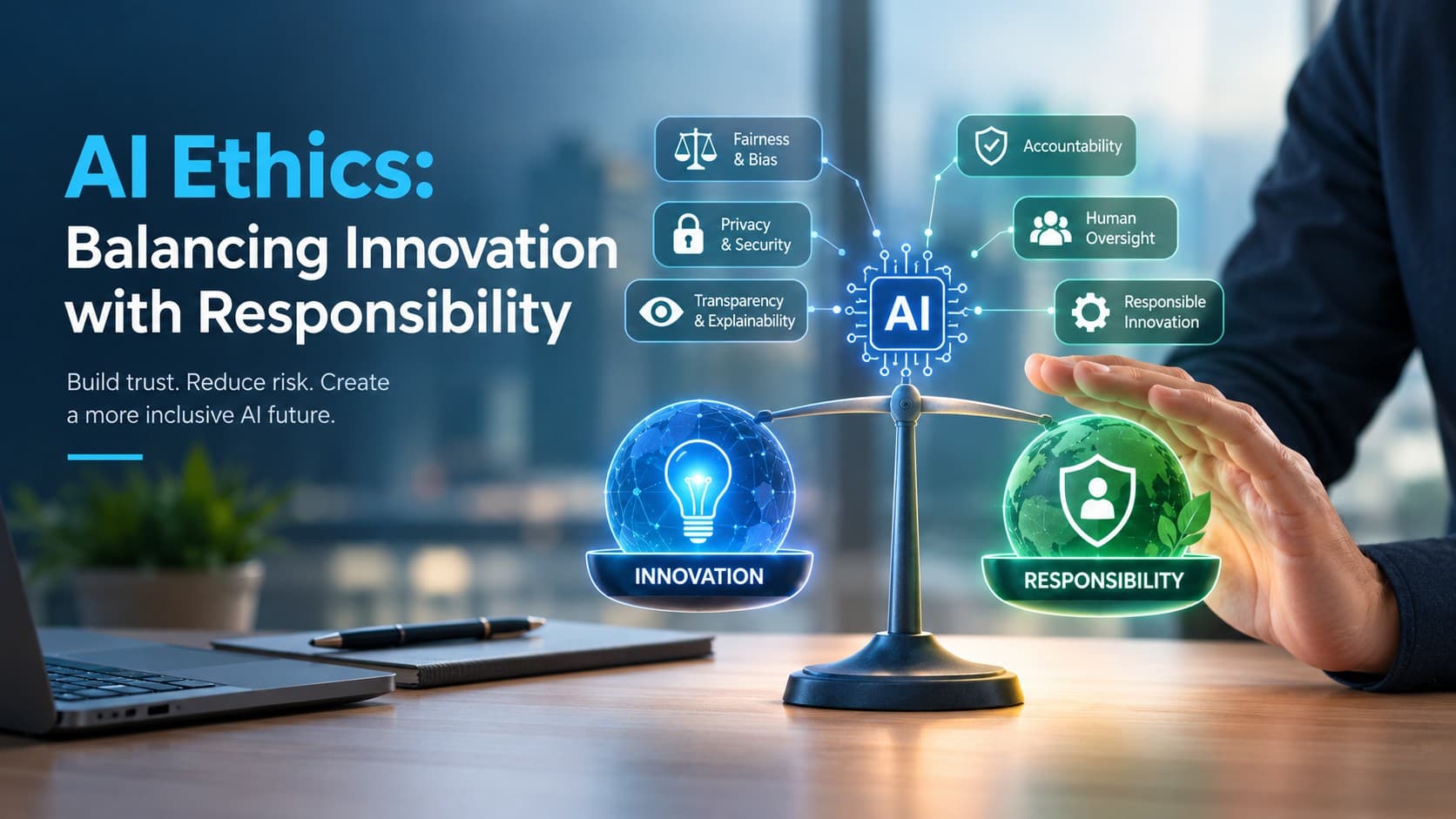
AI ethics refers to the principles and practices that guide the responsible development, deployment and use of artificial intelligence. Responsible AI focuses on ensuring that AI systems are fair, transparent, secure, accountable, privacy-conscious, and subject to appropriate human oversight. A technically advanced system is not automatically a responsible one. Organisations must also consider how decisions are made, who may be affected and whether users can understand or challenge an outcome.
Why AI Ethics Matters
AI is increasingly involved in areas that directly affect people, including recruitment, finance, healthcare, education and customer service.
A biased recruitment model may exclude qualified applicants. An inaccurate healthcare system may produce unreliable recommendations. A generative AI platform may expose confidential business information or create misleading content. These failures can result in a loss of customer trust, reputational damage, regulatory scrutiny, privacy and security incidents, discriminatory outcomes, and significant financial and operational losses. AI ethics matters because automated systems reflect the data, assumptions and decisions used to create them. Without proper governance, existing problems can be reproduced at scale.
The Key Ethical Challenges
Algorithmic Bias
AI systems learn from historical data. If that data contains gaps, inequalities or unbalanced representation, the resulting system may produce unfair outcomes. This concern is especially relevant in facial recognition, recruitment, lending and healthcare. Aventus explored similar issues in The Ethics of Facial Recognition Technology. Organisations should test AI systems across different user groups and review outcomes continuously rather than assuming that automation guarantees fairness.
Privacy and Data Protection
AI systems often depend on large volumes of personal and organisational data. Privacy risks arise when information is collected without a clear purpose, used beyond its intended context or shared with external AI tools without appropriate safeguards. Businesses should define clear rules for data access, storage, retention and third-party use. Employees must also understand what information should never be entered into public AI platforms.
Transparency and Explainability
When AI supports an important decision, users should know that it is being used and should receive a meaningful explanation of the outcome.Transparency does not require businesses to reveal every technical detail. It does require them to explain the purpose of the system, the type of data involved, its limitations and the process for raising concerns or requesting a review. Clear communication strengthens trust and makes it easier to identify errors before they create wider harm.
Accountability
Responsibility cannot be transferred to the technology itself. Every AI system should have a clearly identified owner who is responsible for approval, monitoring, risk assessment and corrective action. Organisations should clearly assign responsibility for approving AI use cases, assessing potential risks, monitoring system performance, investigating incidents, responding to complaints and suspending the system whenever significant issues are identified. Even in highly automated environments, accountability must remain with people.
Overreliance on AI
AI can improve decision-making, but it should not replace human judgement in every situation.Employees may begin to accept AI-generated recommendations without questioning their accuracy. This concern is examined further in Is AI Quietly Taking Over Human Decision-Making?. Human oversight must be meaningful. Reviewers should have the knowledge, authority and time required to challenge or override an incorrect output.
Does Responsible AI Limit Innovation?
Responsible AI does not slow innovation. It strengthens it.
Testing can identify problems before they affect customers. Strong data controls can reduce privacy risks. Clear documentation can improve accountability, while human oversight can prevent harmful decisions. Trust also plays a major role in adoption. Customers, employees and business partners are more likely to use AI systems when they understand their purpose and believe that appropriate safeguards are in place. As competition for AI leadership intensifies, responsible governance will become an important differentiator. Aventus discusses this broader landscape in AI Supremacy: How Countries Are Racing to Lead the Future.
The organisations that create the greatest long-term value may not be those that adopt AI first, but those that adopt it with clear objectives and strong controls.
How Businesses Can Use AI Responsibly
Responsible AI begins with practical governance. Organisations should establish clear AI policies, classify systems according to their level of risk, protect sensitive data, test models for bias and inaccurate outputs, maintain meaningful human oversight, document system limitations and incidents, train employees on responsible AI use, and continuously monitor AI systems after deployment. AI governance should cover the full lifecycle, from planning and development to implementation and ongoing review.
Building a Responsible AI Future
The future of AI will not be determined only by technical capability. It will also depend on whether people trust the systems influencing their decisions and opportunities.
Before introducing an AI solution, organisations should ask:
Is AI appropriate for this purpose?
Who may be affected?
What risks could arise?
Can the outcome be explained?
Is human review available?
Who is accountable?
At Aventus Informatics, we believe innovation creates lasting value when technology is guided by responsibility, transparency and human-centred thinking. Responsible AI is not a barrier to innovation. It is the foundation for building technology that is trusted, sustainable and fit for the future.